10 June 2018

FIFA World Cup 2018


2018 FIFA World Cup  
14 June to 15 July 2018, Russia


Date of Issue : 16 April 2018


From 14 June to 15 July 2018, Russia will host the 21st Football World Cup. The opening match between Russia and Saudi Arabia will take place at the Luzhniki Stadium in Moscow. Monaco Post issued a postage stamp to commemorate this great sporting event on 16th April 2018 featuring two  players fighting for the ball in the foreground and the goalkeeper trying to catch a shot in the background. The stamp shows the flags of the participating nations. The whole picture is shown on the map of Russia with the event venues marked on the map.
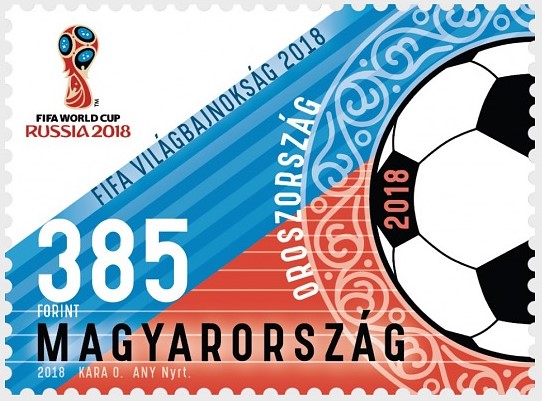


Date of Issue : 25 May 2018


Magyar Posta has issued  a special stamp on 25th May 2018 to mark the 2018 FIFA World Cup. 

All surveys show that football is the world’s most popular sport. Much research has been done by many to explain why this is, but no one has yet found the precise answer. However, several clear conclusions can be drawn from the results of the research. Football’s popularity is unwavering and it is far more than simply a sport because it is a hobby, profession, business and entertainment at one and the same time. Not to mention that it fuels emotions as everyone has an opinion about it, a favourite team and favourite players. Perhaps the most important thing about it is, however, that every country has its own national team, and the best of these are gathering in Russia this year to compete for the 2018 FIFA World Cup™.

32 national teams will play matches in refurbished stadiums in eleven Russian cities between 14 June and 15 July 2018. The hosts automatically take part while the other teams, including the defending champions Germany, win the right to participate by playing in qualifiers. The FIFA World Cup™final is traditionally one of the most watched sports events in the world. Eight nations have lifted the trophy in the 20 finals played to date, Brazil having won the FIFA World Cup™most times, on five occasions. Hungary has reached the final twice – in 1938 and 1954 – and finished as runners-up on both occasions.

Football and philately have intertwined since the early days as Magyar Posta’s first stamps with a sporting theme issued in 1925 included a football scene and the FIFA World Cup™featured in a Hungarian stamp issue in 1962.

The 2018 FIFA World Cup™stamps are arranged in a tĂȘte-bĂȘche format, i.e. in pairs with one stamp upside-down in relation to the other. The main motif of the stamp is a football positioned over two adjoining stamps, thus creating a whole ball, with the colours symbolising the flag of the host nation in the background. The designs of the first day cover and the postmark feature motifs related to the stamp.


09 June 2018

New Stamp from India


 India - South Africa Joint Issue

20 Years of Strategic partnership between India South Africa

 Pandit Deendayal Upadhyay and Oliver Tambo


Date of Issue : 7 June 2018

India Post issued a set of two stamps and a Miniature sheet on 20 Years of Strategic partnership between India South Africa featuring  Pandit Deendayal Upadhyay and Oliver Tambo. External Affairs Minister Sushma Swaraj and Deputy Foreign Minister of South Africa, Luwellyn Landers jointly released postal stamps .


Image Courtesy - Stamps of India

06 June 2018

Superstition and Magic in Slovenia


Date of Issue : 25 May 2018


Slovenia Post issued a set of  five stamps on 25 May 2018 featuring popular superstitions and magic in Slovenia. The stamps feature Witches, black cats, protection of newborn babies, divination, St John's wreath.


One activity that is popular in Slovenia is weaving of St John's wreaths ,which are hung on front doors in Karst villages on Mid summer Night or St John's Eve in order to protect individual houses and the people in them from everything evil and bring good luck.This practice, which is carried out every year,is today listed in the register of intangible cultural heritage.

Many magical actions are also related to the protection of new born children. The most popular one was protection by means of a pentagram or "incubus paw" carved or painted on to the side of the child's cradle. Perhaps, the most popular are of superstition in Slovenia relates to belief in witches,i.e. fabulous or demonic beings, or to trust in people who were able to cast spells,tell fortunes ,prophesy and even heal.

Popular superstitions are associated with animals .A typical example of the latter is the black cat, which is generally held to bring bad luck. Today this phenomenon is present even in car culture ,and a black cat that crosses the street in front of a car is believed to signify something bad, in other words an accident.

Predicting good and bad news ,actions,events and destinies is the stuff of      divination and fortune-telling of many different kinds, including reading coffee rounds. In 19th century special books explaining the symbols created by coffee were written In Slovenia.


New stamp from India


To commemorate World Environment Day a Miniature sheet with 4 stamps of Rs 5 denomination was released by Prime Minister  Narendra Modi on 5th June 2018 in a special function on World Environment Day at New Delhi. India was the host country and the theme of this year was " Beat Plastic Pollution".


05 June 2018

This Day in History… June 5, 1883


Orient Express


US #2576 pictures the Orient Express.
On June 5, 1883, the Orient Express made its first trip from Paris to Vienna.
The world’s most luxurious train was the brainchild of Belgian Georges Nagelmackers. Nagelmackers first became interested in trains on a visit to the United States in 1867. Impressed by the railroad sleeping cars on Pullman night trains, he decided to establish a network of similar trains in Europe.
In 1874, Nagelmackers founded the Compagnie Internationale des Wagons-Lits (International Sleeping-Car Company). To promote his idea, Nagelmackers staged a test run, inviting special guests to take a 1,243-mile railway trip on his Train Éclair de luxe (lightning luxury train). On October 10, 1882, they departed Paris, arriving in Vienna a little over 24 hours later. The train then returned to Paris on October 14.

Korea #2401 honors the first run of the Orient Express.
With that trip a success, Nagelmackers then prepared for regular service. The first run came on June 5, 1883. From then until October 4 of that year, the train ran regular trips between Paris and Vienna. That October, the route was extended to Istanbul by way of Munich, Vienna, Budapest, and Bucharest. Until 1889 (when the rail line was completed) the last leg of the trip (from Varna, Bulgaria, to Istanbul) was completed by ship. The journey took 67 hours and passengers slept on the train for three nights. In 1891, the train’s official name was changed to the “Orient Express.”

Item #MDS494B – Disney souvenir sheet shows the Orient Express running from Paris to Constantinople.
Orient Express service was halted during World War I, then resumed in 1918. The 1930s marked the height of the railroad’s popularity, during which time it ran three parallel services: the Orient Express, the Simplon Orient Express (which took a southern route through Milan, Venice, and Trieste), and the Arlberg Orient Express, which ran through Zurich and Innsbruck to Budapest.
The legendary train became synonymous with luxury travel during the 1930s with its comfortable sleeping cars and restaurant cars that were known for their excellent cuisine. Royalty, diplomats, and wealthy patrons frequently made use of the Orient Express.

Item #MDS494C – Disney souvenir sheet showing the back of the train and a map of the route.
Service was again interrupted during World War II. And by 1962, only the Simplon line was running. Over the years, the line was shortened as passengers chose speed over luxury. France’s TGV or Train Ă  Grande Vitesse (high-speed train) could make the trip from Paris to Vienna overnight. By 2009 all Orient Express routes had disappeared, ending an era of train travel in Europe.
The legendary train has been the setting for mysteries and comedies for decades. In Agatha Christie’s Murder on the Orient Express, inspector Hercule Poirot traveled from Istanbul, then called Constantinople, and solved the mystery of a murder that took place on the train. In addition to using the legendary train as the setting for her story, Christie also used actual events that took place around the time of her writing the book. In 1929, an Orient Express train became trapped in a blizzard similar to the circumstances in her book. Christie, herself, was stuck on an Orient Express train after returning from visiting her husband, an archaeologist on a dig. Some of the characters in her mystery were based on passengers the author became acquainted with while the tracks were cleared and repaired after severe flooding.

Item #MP1939 – Get 300 worldwide train stamps for less than $35!
The Orient Express has also been featured in Bram Stoker’s 1897 book Dracula, Ian Fleming’s From Russia, with Love, and in the 2004 film version of Around the World in 80 Days, among many other books and films.
Source  - Mystic Stamp Company 


World Environment Day


World Environment Day 2018 

Host Nation India Focuses On 'Beat Plastic Pollution' Theme


To raise awareness about protecting the environment, United Nations (UN) has designated June 5 as World Environment Day.Each World Environment Day is organised around a theme that focuses attention on a particularly pressing environmental concern. The theme for the World Environment Day 2018, "Beat Plastic Pollution".


Related Posts with Thumbnails