Showing posts with label Tagore. Show all posts

16 October 2023

My Recent Covers


Ever Onward Congratulations Medal Winners !

19th Asian Games, Hangzhou


Thanks - Jagannath Mani, Bangalore


Commemorative Covers

1.Rabindranath Tagore 2.Sengol Symbol of Transfer of Power


Thanks - Prayag Philatelic Society


International Day of Non-Violence


Thanks - Pradip Jain, Patna

09 May 2021

On Mother's Day - I Cannot Remember My Mother..... by Tagore

 On Mother's Day


Most beautiful poem by Rabindranath Tagore


I cannot remember my mother
only sometimes in the midst of my play
a tune seems to hover over my playthings,
the tune of some song that she used to
hum while rocking my cradle.

I cannot remember my mother
but when in the early autumn morning
the smell of the shiuli flowers floats in the air
the scent of the morning service in the temple
comes to me as the scent of my mother.

I cannot remember my mother
only when from my bedroom window I send
my eyes into the blue of the distant sky,
I feel that the stillness of
my mother's gaze on my face
has spread all over the sky.

By Rabindranath Tagore and translated by Sishu Bholanath


Rabindranath Tagore born 7 May 1861 – 7 August 1941; was  poet, writer, playwright, composer, philosopher, social reformer and painter. He reshaped Bengali literature and music, as well as Indian art with Contextual Modernism in the late 19th and early 20th centuries. Author of the "profoundly sensitive, fresh and beautiful verse" of Gitanjali, he became in 1913 the first non-European as well as the first lyricist to win the Nobel Prize in Literature. Tagore's poetic songs were viewed as spiritual and mercurial; however, his "elegant prose and magical poetry" remain largely unknown outside Bengal. He is sometimes referred to as "the Bard of Bengal".  


First ever Philatelic Exhibition on "Rabindranath Tagore" out side India


First ever Philatelic Exhibition on "Rabindranath Tagore" out side India was held at Cairo, Egypt in July 2011, as part of the year long celebrations to commemorate the 150th birth anniversary of Gurudev Rabindranath Tagore. 


The exhibition was organised by the Maulana Azad Centre for Indian Culture (MACIC), Embassy of India, Cairo in cooperation with the Foreign Cultural Relations Sector and the Fine Arts Sector of the Egyptian Ministry of Culture.  


The exhibition curated by me in Cairo at the invitation of the Kolkata chapter of ICCR was inaugurated by the H. E. Dr Emad Abou Ghazi, the Egyptian Minister of Culture with pomp and grandeur. Exhibits were made from the collection of Mr. Moloy Sarkar besides me. Mr Gopal Biswas of our group also lent his valuable and rare items for the exhibition.


Given here some Print Media Coverage and the facsimile of the bookmark presented to all the visitors.

- Sekhar Chakrabarty : email : sekhar.chakrabarti@gmail.com 


07 May 2020

Philatelic Tributes to Gurudev Rabindranath Tagore


159th Birth Anniversary of Gurudev Rabindranath Tagore


Rabindranath Tagore and The Post Office - a Philatelic Tribute by noted philatelist and artist Shri Dipok Dey is a beautiful book on stamps and other philatelic items issued on Nobel Laureate Gurudev  Rabindranath Tagore all over the world. Sharing here some pages from this book.


Rabindranath Tagorethe first Asian to win Nobel Prize, was born on 7 May 1861 in Kolkata. This year marks the 159th birth anniversary of Tagore. Every year, his birth anniversary is observed as Rabindra Jayanti across the country.


Rabindranath Tagore, one of the most celebrated and revered polymaths India ever had left behind a rich legacy of work inspiring generations across the globe. Tagore, also known as Gurudev played a pivotal role in shaping the Bengali literature, art and music. On his 159th birth anniversary,sharing here some facts about him,


-Rabindranath Tagore was the youngest of thirteen surviving children. He was born in the Jorasanko mansion in Calcutta to Debendranath Tagore and Sarada Devi. Unfortunately, his mother died at an early age and father travelled widely for work. He was nicknamed as Rabi.


--Interestingly, the Tagore family was at the forefront of the Bengal renaissance. Their family published literary magazines; theatre and recitals of Bengali and Western classical music featured regularly.


--Rabindranath Tagore became the first non-European to win the Nobel Prize in Literature in 1913. It was for the beautifully written Gitanjali.


Rabindranath Tagore is the only known person to have written the national anthems for two different countries - Jana Gana Mana, the national anthem for India; and Amar Sonar Bangla, the national anthem for Bangladesh. According to some historians, however, the Sri Lankan national anthem too was based on a Bengali song originally written by Tagore in 1938. It was translated into Sinhalese and adopted as the national anthem in 1951.


--Tagore had a unique vision for school training which he conceptualised and named the school Visva-Bharati. Tagore employed a brahmacharya system: gurus gave pupils personal guidance—emotional, intellectual, and spiritual. Teaching was often done under trees. He staffed the school, contributed his Nobel Prize money, and his duties as steward-mentor at Santiniketan kept him busy: mornings he taught classes; afternoons and evenings he wrote the students' textbooks. He fundraised widely for the school in Europe and the United States between 1919 and 1921.


--Tagore's Nobel Prize was stolen from the safety vault of the Visva-Bharati University, along with several other of his belongings on March 25, 2004. However, on December 7, 2004, the Swedish Academy decided to present two replicas of Tagore's Nobel Prize, one made of gold and the other made of bronze, to the Visva-Bharati University. 


07 May 2017

Philatelic Tributes to Rabindranath Tagore


Rabindranath Tagore
(7 May 1861 - 7 August 1941)


Today, 7th May is the birth anniversary of great Indian Poet Rabindranath Tagore. He was awarded Nobel Prize in 1913 for his book Geetanjali. I am sharing here one of his most beautiful poems - I cannot remember my  Mother... 


I Cannot Remember My Mother :


I cannot remember my mother 

only sometimes in the midst of my play

a tune seems to hover over my playthings, 

the tune of some song that she used to 

hum while rocking my cradle. 


I cannot remember my mother 

but when in the early autumn morning

the smell of the shiuli flowers floats in the air

the scent of the morning service in the temple 

comes to me as the scent of my mother. 


I cannot remember my mother 

only when from my bedroom window I send 

my eyes into the blue of the distant sky, 

I feel that the stillness of 

my mother's gaze on my face 

has spread all over the sky.

- Rabindranath Tagore


07 May 2015

Tributes to Gurudev Rabindranath Tagore


7th May – Birth Anniversary of Gurudev Rabindranath Tagore

image

Today is birth anniversary of India’s greatest literary genius and Nobel Laureate Rabindranath Tagore. Many postal administrations have honored him on their postage stamps. Some of the stamps have been shown here. This Post is a tribute to Gurudev.

image

image

image image  image

Rabindranath Tagore (7 May 1861 – 7 August 1941), was a literary genius who reshaped Bengali literature and music, as well as Indian art with Contextual Modernism in the late 19th and early 20th centuries. Author of Gitanjali and its "profoundly sensitive, fresh and beautiful verse", he became the first non-European to win the Nobel Prize in Literature in 1913.

imageimageimage

In translation his poetry was viewed as spiritual and mercurial; however, his "elegant prose and magical poetry" remain largely unknown outside Bengal. Tagore introduced new prose and verse forms and the use of colloquial language into Bengali literature, thereby freeing it from traditional models based on classical Sanskrit. He was highly influential in introducing the best of Indian culture to the West and vice versa, and he is generally regarded as the outstanding creative artist of the modern Indian subcontinent.

image

image image image


image


Stamp Exhibition on Tagore in Kolkata by Souvik Roy

image

From 9th to 17th May 2015 at Rabindra Tirtha, New Town, Kolkata


26 April 2014

Book on Rabinranath Tagore’ s stamps and covers


Rabindranath Tagore and The Post Office -

A Philatelic Tribute

image

Here is a new beautiful book “ Rabindranath Tagore and The Post Office - A Philatelic Tribute “ edited by noted artist and philatelist Shri Dipok Dey. The book has been published by Rammohun Library and Free Reading Room, Kolkata. Rabindranath Tagore was the first Asian to win Nobel Prize in Literature. He has been honoured by  various countries on postage stamps. This book gives details with colorful illustrations of all the stamps along with First Day Covers, Postmarks, Souvenir sheets, Miniature sheets, special covers, special postmarks, Booklets, Maximum Cards, Picture Post cards ,  catch Covers etc. The cover design and layout of the book by Shri Babul Dey  is excellent. It is a complete book of philatelic items issued on Gurudev Rabindranath Tagore. This book will  be liked by all Tagore lovers as well philatelists.

The first chapter gives “Rabindranath Tagore : A Chronicle : 1861 – 1941 “

The next chapters give details of stamps   issued by different countries in alphabetical order. With the details of stamps other description about Tagore’s visit or  his special association with the country is also given .

After the chapters of stamps, details of covers, postcards,   booklets and Picture Postcards  are  given. The book is hard bound and the quality of paper and printing is very fine. This nice book will add colors to the collection of philatelists and general readers would highly appreciate this book.

The other details of the book are given below :

Rabindranath Tagore and The Post Office - A Philatelic Tribute Edited by Dipok Dey - Hardbound - Pages 64  - Price Rs 575.  - Published by Rammohun  Library and Free Reading Room, 267 Acharya Prafulla Chandra Road, Kolkata – 700009. email : rammohunlibraryafrr@gmail.com

image Dipok Dey is a renowned artist and philatelist of Kolkata. He has designed several Indian stamps, special covers and greeting cards issued by India Post. He has written several philatelic articles and edited philatelic books. He is the first Indian to design UN Stamp in 1985. His specialized exhibit on Cinema  and printing Technology has  been exhibited in many National and International Philatelic Exhibitions.


04 February 2014

New Special Cover..


Centenary Celebration of First Felicitation of Rabindranath Tagore as Nobel Laureate


image


Special Cover on Centenary Celebration of First Felicitation of Rabindranath Tagore as Nobel Laureate - 1st February 2014.

As a part of Centenary Celebration of the First Felicitation of Rabindranath Tagore as Nobel Laureate organised by Rammohan Library and Free Reading Room, Kolkata a special cover was released in Kolkata on 1st February 2014. The cover is designed by Shri Babul Dey.

image

13 November 2013 marked the centenary of Rabindranath Tagore’s Nobel Prize in Literature. Almost 100 years back, the writer, educationist and philosopher was informed of being conferred with the prestigious award. Stating the reasons, the Swedish Academy said that “because of his profoundly sensitive, fresh and beautiful verse, by which, with consummate skill, he has made his poetic thought, expressed in his own English words, a part of the literature of the West”. Born on May 7, 1861, Tagore in 1913 became not just the first Asian Nobel laureate but the first non-European to win the Nobel Prize for literature.

Courtesy : Indian Philately Digest


New Love Stamp from Slovenia


image 

Date of Issue : 31 January 2014

Here is a beautiful stamp from Slovenia to send very special greetings to someone you love !!

Even though an old Slovenian proverb says that the way to someone’s heart is through their stomach, this relationship between two people is first and foremost a matter of the heart. This is also proven by a silver ring from the collection of the Slovenian Ethnographic Museum in Ljubljana formed by two hands holding a heart with a crown and featured on a new Slovenian stamp. The ring thus symbolizes the crown to a couple’s love, which can denote engagement, wedding or merely an objectification of love between two partners. In Slovenia this way of displaying love and affection between the two sexes goes back to the seventeenth century when wedding rings began to be used.
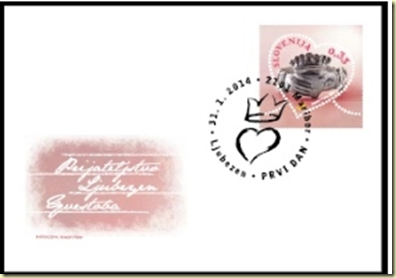
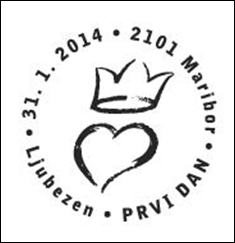
image image

Wearing rings for decoration and the custom of giving a ring to someone as a token of affection developed later on, in the second half of the nineteenth century. The Slovenian word prstan “ring” itself also developed later than some other similar expressions such as rinka, rincica and rincca, which are all derived from the German word Ring “ring, circle”.


Related Posts with Thumbnails