23 July 2025 : National Broadcasting Day
A special cancellation was released by Raipur Philatelic Bureau Chhattisgarh Circle on 23 July 2025 to celebrate National Broadcasting Day. A picture post card was also released on this occasion.
Rainbow Stamp Club is for all Stamp lovers and objective of this club is to create philatelic fraternity around the world.
23 July 2025 : National Broadcasting Day
Date of Issue : 23 March 2015
Monaco Post is to celebrate a special event in history of the country – a launching of the other satellite with a special stamp. The item depicts the satellite itself. The stamp has been already designed and is to be put into circulation on the 23d of March.
A communications satellite or comsat is an artificial satellite sent to space for the purpose of telecommunications. This type of satellite will soon be launched into the Principality of Monaco’s 52°E orbital position. The satellite will cover an area extending from China to the Ocean and as far as Siberia, encompassing 3 billion people.
New stamps from Monaco issued on 5th March 2015
LEGENDARY F1 DRIVERS : MICHELE ALBORETO
An Italian racing driver born in 1956 in Milan, Michele Alboreto competed in 194 Formula 1 Grand Prix races between 1981 and 1994. In 1985, with Ferrari, he finished second in the world behind Alain Prost. In 1995, he switched to sports prototypes. He was killed in 2001 on the German Lausitz circuit while training for the Le Mans 24 Hours race. Michele Alboreto has remained in the hearts of his fellow Italians as a fiery, talented driver.
LEGENDARY F1 DRIVERS : GRAHAM HILL
Born in London in 1929, Graham Hill won the Formula 1 World Championship title in 1962 and 1968. Having also won the Indianapolis 500 in 1966 and the 24 Hours of Le Mans in 1972, he is the only driver in history to win the Triple Crown of Motorsport. For many years, he held the record for the number of Monaco Grand Prix victories (five). His record was broken in 1993 by Ayrton Senna, who, in a twist of fate, defeated Hill’s son, Damon, in the race. Graham Hill died in 1975 at the controls of his private aeroplane.
UNIVERSAL EXPOSITION MILANO 2015
MILANO 2015 will take place in Milan from 1st May to 31st October 2015. The exhibition’s theme is “Feeding the Planet, Energy for Life”, and it is the first Universal Exposition to focus on food security and food diversity. Monaco’s involvement was confirmed in 2011 by H.S.H. Prince Albert II. Built by Italian architect Enrico Pollini, the Monaco Pavilion will highlight the Principality’s international humanitarian efforts and techniques for a healthy diet.
The telegraph service in India, which was launched in 1851, will formally close down on July 15. Many philatelists are making this day very special by sending the last telegram to each other and making the last telegram a memorable and collectible item for a life time. I am sharing this news clipping here sent by Mr Mahesh Parekh of South India Philatelists’ Association, published today in Chennai edition of Times of India. The news covers the special plans of sending last telegram by Mr CG Bhaskar and other members of South India Philatelists’ Association on 15th July to make this day memorable. This news will certainly encourage many philatelists to send the last telegram on the very last day of this service !!
In dying days, almost-forgotten telegraph service returns to life
CHENNAI: Philatelists, collectors, and those with a penchant for nostalgia have decided to use July 15—the day BharatSancharNigamLimited will its 160-year-old telegram service — to pull out all the stops.
As telecom and IT minister Kapil Sibal plans his ceremonial send-off for the telegram on July 15, C G Bhaskar, treasurer of South India Philately Association, has made calls to various telegraph offices in the city to make sure they will still be functioning on July 15. He and his fellow philatelists plan to go in and send telegrams.
"Some of us will be sending telegrams on July 14, others on July 15. It will be among the last telegrams the world will see and that will make them collectors' items," says Bhaskar, who has also been contacted by philatelists from other southern states to send them telegrams. The association is planning to hold an exhibition of telegrams after the service ends.
According to G Vijaya, spokesperson for BSNL, there are more than 20 centres in Chennai that will offer the telegraph service till July 15. "The service will be preserved till its end," she says. Another official at BSNL's Anna Nagar branch says that people are still coming in to use the service.
Philatelist Vedachalam Ethiraj, who is also known for his telegram collection, says he plans to send a telegram on July 15 to complete his collection. "I have telegrams that were sent in 1859, six years after the telegraph service started in India. I want to get one sent in 2013 to complete my collection," says Ethiraj, who has sent a telegram from Karaikudi to Rangoon. He, like Bhaskar, plans to send telegrams with messages like 'This is the last telegram' to his relatives and friends and ask them to post them back to him for his collection.
It's not just philatelists who are keen on sending telegrams. Ramya Murali, a human resources manager with Real Image, is planning to surprise friends and relatives by sending them telegrams on July 15. "I have called the telegraph office near my house and they told me they are working till July 15. I will go there and pick out nice messages to send to everyone. Just thought it would be a good surprise for them," she says.
Bhaskar won't just be sending out telegrams, he'll be calling his relatives to warn them before shooting off the telegrams. "I don't want them to think something bad has happened and get worried. So, I will call first to tell them about the farewell telegram," Bhaskar says.
Published in - Times of India : 18 June 2013, Chennai
: Mahesh Parekh, Chennai
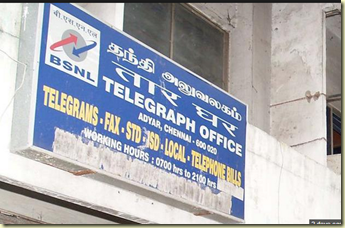
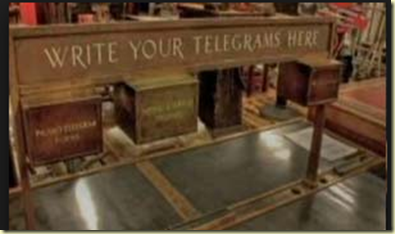
The state-run Bharat Sanchar Nigam Ltd (BSNL) has scheduled July 15 as the final day for a service launched by the British in the 1850s and which in the days of snail mail was one of the quickest modes of communicating joy or sorrow between near and dear ones. Here are some pics of Telegraph offices in India which will disappear after a month…
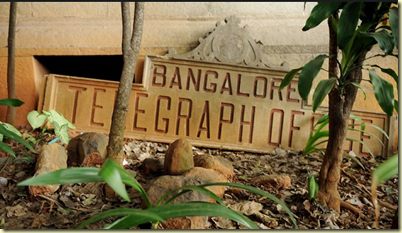
I am sharing here an article by Jonathan DeHart published in Asia Life
On July 15 India will send its last telegram, drawing a line under the nation’s British Raj past and its silicon chip-driven future.
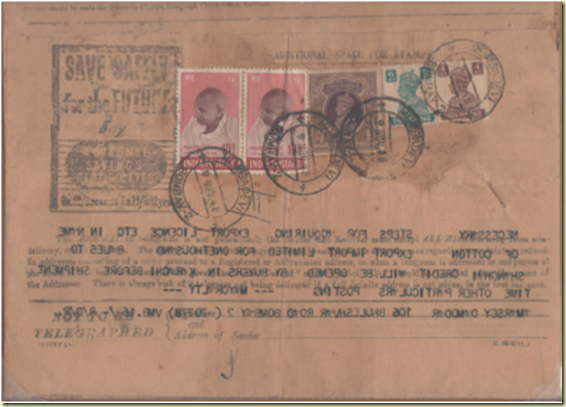
Since the time when the Subcontinent’s first telegram was transmitted 163 years ago – about 50 km from Calcutta to Diamond Harbour – the nation has gained independence, become the world’s largest democracy, and seen its economy explode as it transforms into an information technology giant. As of 2011, government-owned telecom powerhouse BSNL (Bharat Sanchar Nigam Ltd) was suffering losses of Rs. 300 – 400 crore from its telegraph service.
“The growing use of mobile phones and Internet has led to steep decline in the usage of the telegraphic service…it has become financially unviable,” a BSNL official told The Hindu. “After stopping telegram service for overseas communication earlier this year, we have now decided to discontinue it for the domestic market from July 15.”
The move is inextricably tied up with the advent of mobile phones and the Internet – now accessible to800,000 and 150 million Indians, respectively. Interestingly, rather than cease use of the technology, BSNL upgraded its telegram service – taar in Hindi – to include web-based messaging as recently as 2010. It follows logically that BSNL employees once assigned to telegraphy are being transferred to mobile, landline and broadband services over the next three months.
Present-day Indians use these newfangled technologies for essentially the same purposes as the beloved telegraph machine that was once the lynchpin of the country’s communications network.
“Currently, we send only about 5,000 telegrams per day,” a BSNL official told The Telegraph, which notes that telegrams are still available as retro-greeting cards in the UK, Germany, Canada and Russia. “That's down from several hundred thousand a day before the advent of the fax machine.”
By late afternoon on Thursday, Delhi’s Central Telegraph Office estimated that it had dealt with no more than 250 messages in total.
“In recent years, out of the 5,000 telegrams sent daily 95 percent were used by government departments and remaining 5 percent by people from rural India. The ages of senders have not been an important factor,” Pradip Jain, chairman of communications at the Bihar Chamber of Commerce, told The Diplomat.
Use of telegrams in India began with the Raj when William O'Shaughnessy, a surgeon and inventor, was commissioned by Indian Governor Lord Dalhousie to build a 27-mile line near Calcutta. By 1856, the lines had become a complex network that spanned some 4,000 miles of the British Empire. By connecting important hubs like Mumbai (then Bombay), Agra, Peshawar and Madras, the British East India Company took control of the vast swathe of terrain.
Over the next 90-plus years, telegrams carried messages that defined the nation’s history, from its use by the British to put down the Indian Rebellion of 1857 to Jawaharlal Nehru’s message to British Prime Minister Clement Attlee, in which the first Indian prime minister requested help from London when Pakistani troops invaded Kashmir.
“We have received urgent appeal for assistance from Kashmir government,” Nehru wrote in a famous, 163-word message. “We would be disposed to give favourable consideration to such request from any friendly state.”
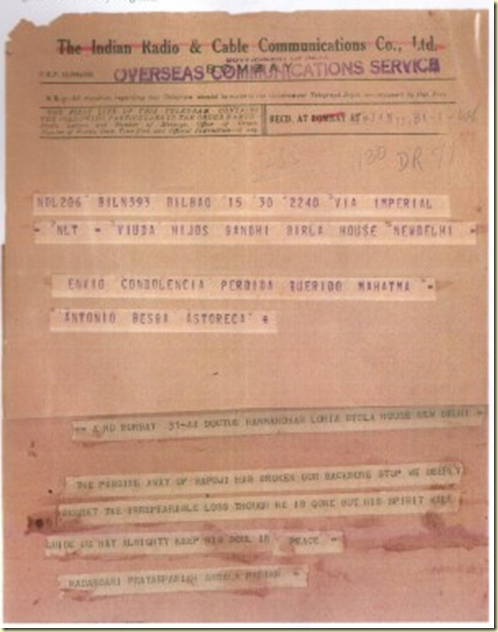
Jain added to this list the message that bore then news of the assassination of Mahatma Gandhi, whose image was later emblazoned on the stamps that later covered telegrams.
While telegrams lost the urgency they once had, people have still frequented the nation’s telegraph offices in recent decades to send news of births, deaths, marriages and other news of consequence to family across the country or among the diaspora.
“Birthdays, grieving, condolences, interviews, bank statements – I have sent everything,” VL Meena toldThe Independent.
“There are several places where mobile phone services haven't reached,” Satish Kumar, a telegraph clerk in New Delhi, told NDTV. “In places like Siachen, lots of soldiers still communicate to their family through telegrams. Plus navy recruitments are still sent through telegram.”
What’s most amazing of all to consider is that India has held onto this antiquated piece of technology this long. For some, the answer is purely practical. Jain in Bihar said, “I would not say that nostalgia held the delay in shutting the telegraph facility. It was more due to lack of cheaper mode of fast communication and huge losses mounted by BSNL to the tune of $4 billion.”
Yet, for others the technology was more than the sum of its parts and they feel a nostalgia for its passing.
“The postman fishing out a telegram from his satchel is an abiding image in many of our earlier movies, at least for those of us of a certain age,” an editorial in The Hindustan Times reads. “The recipient would tear it open with trembling hands, for there was always an element of urgency about a telegram.”
The Indian Express writes: “Tersely worded, printed out in capital letters, sentences ending with the dramatic ‘STOP’, nothing can bring it home like a telegram.”

Date of Issue : 30th May 2013
Her Majesty the Queen – Six Decades of Royal Portraits stamps from Royal Mail
Portrait Cards & Framed Royal Portrait Stamps
To mark the 60th anniversary of the Queen’s Coronation, Royal Mail has created an extraordinary collection featuring some of the finest portraits of Her Majesty Queen Elizabeth II. The portraits are the following (in chronological order):
1953 Terence Cuneo – 2nd Class; it was the Queen’s representatives, the Lord- Lieutenants of England, Scotland, Wales and Northern Ireland, who commissioned Cuneo to paint the Coronation. The artist attended all eight rehearsals for the event then began painting in the early morning of the Coronation, sketching for eight hours straight. The painting featured on the stamp is a preparatory oil sketch depicting the Queen alone, executed with great liveliness of brushwork and intensity of colour, seen especially in the abstract haze of light surrounding the figure.
1955 Pietro Annigoni – 88p; this celebrated portrait was commissioned in 1954 by the Worshipful Company of Fishmongers for their magnificent hall overlooking the Thames.
Pietro commented how in awe of the Queen he was, until she began chatting to him in French. She told him that as a child she liked to watch the world go by from the windows of Buckingham Palace. It was at this moment Pietro realised what his portrait should convey: “the Queen who, while dear to the hearts of millions whom she loved, was herself alone and far off.”
1992 Richard Stone – £1.88; in 1989, Richard Stone’s home town of Colchester celebrated its 800th anniversary of its Royal Charter; a portrait was commissioned to mark this occasion then later unveiled at the National Portrait Gallery. The artist’s style is intended to match the grandeur and dignity of the golden age of British portraiture. The profile view adds an element of gravity and introspection. After seeing the finished work, the Queen remarked somewhat prophetically, “it will make a good stamp”.
1999 Andrew Festing – 78p; commissioned by the Royal Hospital Chelsea, this portrait is displayed in the entrance hall of its museum. The Queen is shown at Chelsea Hospital, on the steps leading to the Council Chamber. She wears the regalia for the State Opening of Parliament – the Parliamentary Robe of State and the Diamond Diadem. Her traditional costume conveys the continuity in British life of which the monarchy is the most powerful expression.
2000 Sergei Pavlenko – £1.28; commissioned by the Worshipful Company of Drapers to celebrate the 50th anniversary of the Queen becoming a Freeman of the Company, this painting hangs in the Court Dining Room at Drapers’ Hall. Unveiled in November 2000, the portrait shows the Queen in Garter robes with one unusual addition – the Drapers’ brooch, presented to Her Majesty in 1947. Pavlenko’s image conveys the Queen as the nation’s most exalted and famous hostess, welcoming hundreds of people every year to Buckingham Palace.
2013 – 1st Class; this portrait was commissioned by Royal Mail especially for this collection and shows the Queen in Garter robes. The artist demonstrates mastery of paint, with the Queen’s head carefully described yet with remarkable animation in the brushstroke and expression. The finished piece shows the Queen wearing the regalia of one of her offices with an easy and cheerful assurance. The portrait expresses Her Majesty’s joy and quiet
Yahsat - UAE's Communication Satellite
Emirates Post issued a commemorative stamp on communication sattelite “ Yahsat” in May 2013 .
Yahsat is a satellite communications company wholly owned subsidiary of Mubadala Development Company, the Abu Dhabi Government's strategic investment company. The company offers voice, data, video and internet services for broadcast, Internet and VSAT users for both private and government organisations.
Incorporated in January 2008 the company had an aim of developing, operating and using multi-purpose (Government and commercial) communications satellite systems for the Middle East, Africa, Europe and South-West Asia regions. Yahsat products includes Satellite Broadband Internet, Satellite Broadcast, Secure Satellite connectivity.
: Kenneth Sequeira – Dubai : email : kenneth.sequeira@hotmail.com
Korea Post issued a set of 4 commemorative stamps featuring wireless communication, postal communication, broadcasting communication, and scientific technologies/human/hope in commemoration of the “ Information and Communication Day ”. The set is beautiful and one of the stamp features a Rainbow too. The set could be included in various themes like communication, Cartoons, Science and Technology as well as Rainbow.
The rapid development of communication technology has dramatically changed the world. The “pony express” and “signal fire” have evolved into the postal system, telegraphic communication and telephone, computer, wired/wireless communication, and satellite communications, expanding our spheres of life to a remarkable extent. As shown by the Internet, created by the splendid imaginations of two persons to transform the world, as well as by the emergence of smart phones which became another new watershed, the combination of the power of human imagination with innovative technologies is leading mankind to a new progression day by day.
News from our Members…
Letter Box used as Dustbin
Recently I have been to Nainital and while walking on the Mall Road, near the library I found the letter box which has been used as dustbin, instead of a letter box. As a philatelist it was really embarrassing to see… Is this the future of Postal Department in India ?
- Atul Agarwal , Aligarh
Joint issue between Pakistan and Iran on Minar-e-Pakistan and Milad Tower Iran
Date of Issue : 24 August 2011
Here are some recent issues from Pakistan issued during months of June to August 2011.
Celebrating 60th Anniversary in Managing Frequency Spectrum for bringing Socio-Economic by Frequency Alocation Board in Pakistan
Date of Issue : 18 August, 2011
On the Eve of Golden Jubilee of Zarai Tarqiati Bank Limited
Date of Issue : 14 August, 2011
Date of Issue : 17 July, 2011
On the Occasion of Golden Jubilee of the Institute of Chartered Accountants of Pakistan (ICAP)
Date of Issue : 1 July, 2011
Child Art Competition : National Stamp Exhibition "KURACHEE 2011"
Date of Issue : 24 June, 2011
Pakistan-Russia Friendship
Date of Issue : 10 June 2011
HIV AWARENESS CAMPAIGN
Date of Issue : 8 June 2011
Date of Issue : 17 January 2011
Kay Mail
Greenland Post issued a set of 3 stamps on 17 January 2011 featuring communication in Greenland in different era. Kay mail was the special way to transport mail in 17th and 18thn century.
Greenland is an autonomous country within the Kingdom of Denmark, located between the Arctic and Atlantic Oceans, east of the Canadian Arctic Archipelago. Though physiographically a part of the continent of North America, Greenland has been politically and culturally associated with Europe (specifically Norway and Denmark) for about a millennium. The largest island in Greenland is also named Greenland, and makes up most of the country's land area.Greenland is, by area, the world's largest island that is not a continent. With a population of 56,615 it is one of the least densely populated dependencies or countries in the world.
Kay Mail
Kay mail was the common way to transport mail in the old days. This was, of course, as a supplement the dog sledge transport. The kay mail letters were folded in a certain way so that they would fit into a kamik, the traditional Greenlandic boot.A few of the kay mail letters, back from the 17th and 18th centuries, are preserved in private collections today. During the 1950s and 60s, as motor boats were more common in Greenland, the need for kay mail disappeared gradually.
In 1861, the newspaper Atuagagdliutit, was founded. The Danish geologist, Inspector H.J. Rink started the newspaper in Nuuk. H.J. Rink believed that the population of Greenland was losing its cultural identity. The newspaper Atuagagdliutit was, from its conception only printed in the Greenlandic language.
During the Second World War there was also printed a Danish-language newspaper in Nuuk with the name “Grønlandsposten”. In 1952 Atuagagdliutit and Grønlandsposten were merged into a single two-language newspaper. In everyday language the newspaper is therefore called ”AG”.
POST Greenland's holding company, TELE Greenland A/S, established during the period 2006 - 2009, the submarine cable Greenland Connect, which began operation on 23rd March 2009. For large parts of Greenland, the submarine cable enabled a much faster IT and telecommunications link in and out of Greenland than the previous satellites. With the submarine cable, large parts of Greenland were now connected to what is popularly known as broadband.
The cable goes from Newfoundland in the west across Greenland, to Iceland in the east, from which the submarine cable is powered. All these stations only supply green energy.
The submarine cable has improved communications between Greenland and the rest of the world considerably
Date of Issue : 8 June 2011
Fiji Post issued a set of four stamps on 8 June 2011 in global response to HIV AIDS Prevention. Fiji is made up of about 332 islands covering some 650,000 square kilometres of ocean. From 1874 to 1970, Fiji was a British colony. The population totals some 700,000 people.Fiji is classified as a low HIV prevalence country; however the number of new HIV infections is increasing.
Stamp Designs
Protect youth from HIV and Zero new infections (20c stamp, 40c stamp)
In Fiji HIV is mostly transmitted through unprotected sex, and there is a potential high risk of infection among young people. In 2010 more than half of all new infections, 23 of 33, were in young people aged 10-29. The high prevalence of sexually transmitted infections especially among young people, potentially increases the risk of HIV infection. It is therefore essential that young people are empowered to protect themselves from HIV infection.
Prevent mothers and babies from HIV (65c stamp)
In 2010 there were 33 new reported cases of which 12 were pregnant women, but there were no babies born HIV positive in 2010. Government has ensured the prevention of parent to child transmission as one of its main focus areas in the national response to HIV. The awareness of the availability and benefits of voluntary counselling and testing for pregnant mothers resulted in the increase of testing in the ante-natal clinics from 46% in 2006 to 67% in 2010.
Zero discrimination ($5 stamp)
HIV related stigma and discrimination continues to hamper the AIDS response. This year the Fiji Government enacted the HIV Decree. When enacted to its capacity the Decree safeguards the privacy and rights of people living with or affected by HIV, including confidentiality of personal information.
Special Covers
Many collectors often enquire about special covers issued by different postal circles.The series of special Covers, issued in different states of India is being published for the cross reference of thematic collectors. The cancellations on the covers might become a part of their topical collections.
Maharashtra
Telecommunications Consultants India Ltd. : 4 August 2011
150 glorious years of Railways in India : 28 September 2003
: Ashwani Dubey, Gorakhpur