Mirzapur Handmade Dari
2 January 2026 : Mirzapur Handmade Dari : Mirzapur
Rainbow Stamp Club is for all Stamp lovers and objective of this club is to create philatelic fraternity around the world.
Mirzapur Handmade Dari
2 January 2026 : Mirzapur Handmade Dari : Mirzapur
Nationql Handloom Day
7 August 2025 : Raipur
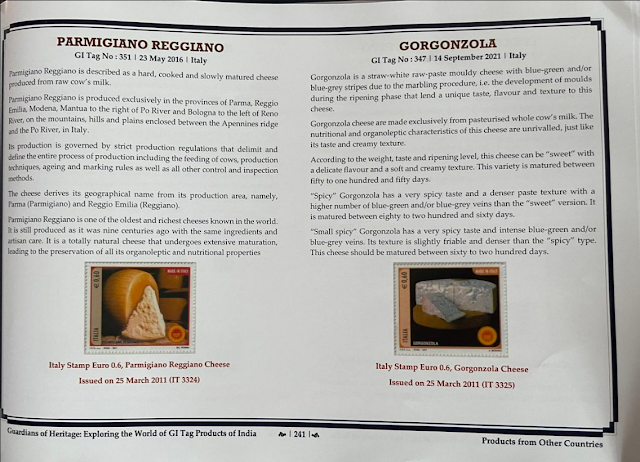
Guardians of Heritage
Exploring The World of GI Tag Products of India
- Senthilkumar Chandrasekaran
Guardians of Heritage : Exploring the Wold of GI Tag Products of India by Senthilkumar Chandrasekaran : First Edition 2025 : Published By Mohanapriya Senthilkumar : ISBN 978-93-342-5045-9 : Copyright : Senthilkumar Chandrasekaran : Pages: 280 : Size A4 : Type Hardbound : Price: INR 1950: Author email : csenthilkumar78@gmail.com
A new book “Guardians
of Heritage by Senthil Kumar Chandrasekaran” is an excellent book on different
philatelic items related to Geographical Indications.
GIs have been defined under Article 22 (1) of
the Agreement on Trade-Related Aspects of Intellectual Property Rights (TRIPS)
as: "indications which identify a good as originating in the territory of
a member, or a region or locality in that territory, where a given quality,
reputation or other characteristic of the good is essentially attributable to
its geographic origin.
India, with its vast cultural and ecological diversity, has given GI recognition to a variety of products ranging from the agricultural products, food products Handicrafts which promote the tapestry of culture and craftsmen, Manufactured products which show case the indigenous capability, to the natural products of India like the Makrana Marble. India Post has issued stamps, special covers, cancellations and other postal memorabilia to promote these GI Tagged Products of India.
This book is based on author’s collection of philatelic items related to Geographical Indications. The book is a tribute to the GI Tagged Products. The author has shown different philatelic items like Stamps, Miniature sheets , Special Covers, Special Cancellations, Permanent Pictorial Cancellations, Picture Postcards, Meter Marks, and other items issued by Deptt of Posts. related to GI products .
The printing and layout of the book is excellent. There are about 600 multi coloured images covering different philatelic items from India and other countries. The book is very useful for all thematic collectors as well as for non philatelists too as it gives a comprehensive information on a variety of special GI Products of India. The author has given details about each item very systematically so it is a very good refence book for everyone.. The book will prove to be an asset for all philatelists and book lovers. This book is specially recommended for School and college libraries as it has lot of information on a variety of interesting products from different parts of India and other countries. It will enrich the knowledge of students about many special products and the rich heritage of our country. Thematic philatelists will find this book very interesting as the author has tried to show different types of philatelic items in the book which are part of a thematic exhibit, I recommend this book for every thematic collector as well as people from all walks of life of every age group.
ABOUT THE AUTHOR
Sikki Grass Craft : 24 August 2021 : Darbhanga
New Picture Postcards on Fishes by Odisha Postal Circle
On 1st April 2021 Central Institute of freshwater aquaculture with India Post a set of 12 picture postcards were released by Sri P.K.Bisoi, Secretary, Posts in presence of distinguished guests. The post card blank set cost ₹125/- where as cancelled set cost ₹200/- .
For more details plz contact : Dr Bibhudutta Mishra,Bhubaneshwar : Whatsapp no 7978551080
New Special Covers from Gujarat Postal Circle
Six Special Covers on Handloom and Handicraft Products of Gujarat were released on 6th April 2021 at Vadodar
Image credit : Philately Promoters
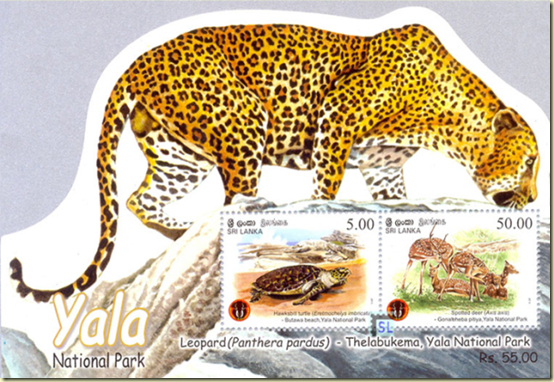
Date of Issue : 28 July2013
The Philatelic Bureau of Sri Lanka issued six new postage stamps in the denominations of Rs. 5.00, Rs 15.00, Rs. 30.00, Rs. 40.00 and Rs. 50.00 depicting six selected animals living in the Yala National Park to coincide with the completion of seventy five years of the network of Wild Life Reserves in Sri Lanka, as the fourth issue in the series of stamps on Sri Lanka’s National Parks.
As for the objectives of the Wild Life Reserves Network of Sri Lanka which has evolved for a period of seventy five years now since February, 1938, in addition to the long term protection of Wild Life resources, it contributes to a large extent to the national economy of the country as well.
1.Hawks-bill Turtle ( Eretmochelys imbricate)
Growing to about 3 feet in length, this member is one of eight species of sea turtles recognized in the world, and one of the five that inhabit the coastal waters of Sri Lanka. All turtles are considered globally threatened and live by feeding on sea weeds, grasses, jellyfish, corals etc. They come ashore to lay eggs in a nest dug in the sand with their flippers. A total of 20-40 or more nicely round white eggs are laid in the dugout cavity at night when they beach for nesting. The eggs are covered with sand using the flippers and pressed with body thumping. The nestlings hatch out in approximately 23-26 days and head out straight to sea. The yolk sac in the belly is supposed to provide the initial energy for the hatchlings to swim as far as possible to the reef areas. They do not come back to land until mature and ready to breed, the age of which has not yet been established. The nesting beach is believed to be the same area from where it left as a hatchling. The use of its carapace scales for ornamental accessories by humans is the biggest threat to its survival.
2.Swamp Crocodile( Crocodylus palustris )

Crocodiles are members of the reptilian group, and are considered to be in the direct line of evolution to birds. They possess a heart with a left aortic blood vessel like the birds and different from the other reptiles. Sri Lanka is blessed with two species – the marsh or swamp crocodile and the larger and more aggressive estuarine crocodile – Crocodylus porosus inhabiting generally the salt waters. The swamp crocodile grows to about 10 - 12 feet, with webbed fingers, dorsal nares and a nasal track separated from the mouth by a palate. They are efficient swimmers paddling with the dorso-ventrally flattened tail. Crocodiles build nests in dug-up cavities in the embankments of rivers etc. in which they lay eggs that are hatched by the addition of decaying vegetation. Crocodiles are very protective of their young and are most aggressive during the period when the young hatchlings are around. They are carnivorous and feed of dead carcasses or captured animals.
3.Elephant( Elephas maximus )

The largest animal on the Asian continent, the elephant is related to the African elephant in being in the same Family Proboscidea. The main feature of recognition is the presence of the prehensile nose or proboscis. An average animal can grow up to about 7-9 feet at the shoulder. They are herbivorous and need around 1/3rd their body weight in foliage per day. The Sri Lankan elephant feeds 70% on grasses and balance on vegetation plants of around 10cm in diameter at breast height. Thus it has been recognized as an “edge species” loitering and feeding in high densities in forest with heavy scrub, open grasslands and water. The cause for damage to property, crops and consequently even to human life is believed mainly due to this preference of food and a unique feature in its feeding biology. The grinding capacity of the molar teeth that replaces over the years fails to be effective and efficient in old age and a preference for softer lush “agricultural” food draws them to human habitation. The continued encroachments of their territory by humans have compounded the conflict further. The elephant tamed by us has become part of our culture and religious practices. Among the Asian elephant it is only the male that bears the magnificent tusks, a sad cause for its state of threatened status.
4.Black-necked Stork( Ephippiorhynchus asiatucus )

The tallest bird of Sri Lanka with a height over 5 ft. It inhabits coastal wetlands such as marshes, lagoons, estuaries and large water bodies. A bird that had a distribution in the North West and East of Sri Lanka is presently, sighted often in the wetlands of the Yala National Park Complex. There has been numerous sightings of birds caring sticks for nesting and juvenile birds, yet no documented nest has yet been seen in the country in the last 50 years or more. It is known to nest in tall trees away from the coastline in forests.
5.The Wild Boar (Sus scrofa)

An interesting member of the hoofed family - Artiodactyla, they live in small sires, numbering around 4- 5 animals. Moving through the soft earth, like a plough they dig up for yams and grub worms etc. The area left behind after a successful feeding bout is a completely upturned soil. They like to wallow in mud. The babies are lined with black horizontal marks and number up to even 10 in a pack. The male has a fairly large pair of tushes and the females too sometimes have smaller pairs. The adult animals are very protective of their babies and will not hesitate to take on even a leopard if it happens to stalk the babies.
6.The Spotted Deer (Axis axis)

The most common mammal is in the dry and semi arid forest in the country. Generally they are observed in herds of half a dozen to a hundred or more, of both sexes and all ages .
Spotted deer spends much of its time grazing upon various grasses and herbs in open areas in the forests. They browse on the leaves of bushes, saplings and scrub vegetation also. They are also very fond of the fruits and flowers that fall from the forest trees.
The main predators of this beautiful animal are leopard and crocodile. Their vision and hearing are exceedingly acute and their sense of smell is very well developed. These adaptations help them to escape from predators.
New Stamps from Oman
Omani crafts Day 2013 !!
: Pradip Jain – Patna
Hi !
Russian Post issued a set of 4 stamps in sheetlet form featuring famous Russian Shawls. I am sharing here information about Russian shawls. It just caught my attention as the place, Kullu where I live is famous for shawls all over the world. It is really nice to write here about shawls of Russia …
Russian post issued a set of stamps dedicated to Arts and Crafts of Russia and depicting shawls produced by Pavlovopasadsky, Orenburg, Karabanovsky and Trekhgorny manufactories.
Pavlovopasadsky products represent a riot of lush garden and wild flowers in the corners of a shawl with garland on the border, as well as oriental ornaments imitating Indian and Persian shawls. This Moscow province was also famous for its production of patterned silk fabrics and scarves.
Orenburg shawl is a knitted shawl made of goat’s wool and base (cotton, silk and other). There are several kinds of Orenburg shawls:
Simple shawl – grey (rarely white) thick warm downy shawl. With the production of these shawls the Orenburg knitting industry was launched. This is the warmest kind of shawl which was used for everyday wear.
Gossamer – laced fabrication from goat’s wool and silk. It was used in ceremonies, festive occasions, as the schemes and techniques of knitting were much more complex than in the case of a simple downy shawl.
Tippet – a thin scarf/cape analogical to gossamer by the technique of fabrication and manner of use.
Shawls of Troetsko-Alexandrovsly manufacture of Baranovy traces its history from 1846.
Multicolored floral patterns played a major role in product’s ornamentation. The red colour, present in each element, united central part and border, background and main pattern. Along with floral patterns the Baranovsky shawls had geometric and Oriental (“cucumber”) motifs.
Among the diverse range of Trekhgorny manufacture scarves and shawls played an important role. Most products had a “classic” ornament: broad border with a lush flower garland, large central part with rhythmically balanced bouquets or branches, creating a feeling of static pattern.
Club News
Uttarakhand: Relief Material to be Dispatched Free by Postal Department
Department of Posts has decided to dispatch Parcels of relief material free of postage charges for providing help to the victims of natural calamity of Uttarakhand State. This facility is made available in various Post Offices where the parcels upto 35 KGs of relief material such as clothes, blankets, woolens, bedsheets, medicines, tarpaulin, plastic sheets, torch, long shelf-life food etc can be booked free of charges.
The Parcels should be marked as “Relief Material for Uttarakhand” and addressed to “The Senior Postmaster, Dehradun GPO, Dehradun-248001 (Uttarakhand)”. For any information call on 011-23632391 or email: adpo-dl@indiapost.gov.in This free of charge facility will be available upto 20th July 2013 only.
Source : Indian Philately Digest