Showing posts with label Iceland. Show all posts

11 February 2019

Centenary of Union of Postal Workers , Iceland


Date of Issue: 2 February , 2019


Centenary of Union of Postal Workers

New stamp from Iceland featuring  Postman's Uniform and accessories in countries with extreme weather conditions.


The Icelandic Postal Workers Union was founded in Reykjavik on March 26, 1919. The history of Icelandic postmen can be traced back to 1776 when King Christian VII issued a directive establishing domestic postal services in Iceland. The first Icelandic mailman was Ari Guðmundsson, who travelled extensively with mail through the forbidding mountain regions of the Westfjords. 


When the union was formed, the Icelandic labour movement was in its early stages. Iceland had recently gained sovereignty and there was a general sense of social recovery and revival. In 1932, its members were 73 in number, but today they number 900. The union´s main task is to safeguard the interests of Icelandic postal workers and to ensure improvements in their working conditions. 

The Icelandic Postal Workers Union has grown a lot in stature with its growing membership numbers. It is now one of the strong pillars of the Federation of State and Municipal Employees (BSRB) and an important force in the labour movement. In 2001, only one quarter of the members were still employed by the official Post and Telephone, which on January 1, 1997, made way for Post and Telephone Ltd. and a year later Iceland Post. Despite these changes, the union continues to promote social justice and foster human values.

-  Iceland Post ; Kasinath R.- Tanjore


04 August 2017

2017 -Year of Sustainable Tourism for Development


Date of Issue : 27 April 2017

Here is a beautiful set of stamps issued by Iceland Post on 27 April 2017. The set commemorates 2017-Year of Sustainable Tourism for Development . The United Nations have declared 2017 as the Year of Sustainable Tourism for development. Sustainable tourism is defined as the development or activities in tourism that respect the environment and ensure long-term protection of natural and cultural resources

Year of Sustainable Tourism for Development


The Blue Lagoon

. The Blue Lagoon in the Reykjanes peninsula formed in 1976, fed by the water output of the nearby geothermal power station in Svartsengi in Grindavík. It soon became clear that bathing in the lagoon had positive effects on the psorisasis skin disease. The reservoir has over time become one of the most popular tourist destinations in Iceland. Its ecosystem is one of its kind in the world. The lagoon holds nine million liters of geothermal seawater which is renewed every 40 hours. Its temperatue is of 37-39°C.

The Mývatn Nature Baths

 The Mývatn Nature Baths are located close to Reykjahlíð. Since the settlement period they have been used as health baths. They consist of natural saunas, nature baths with hot spring water and hot tubs. Mývatn is Iceland‘s fourth largest lake and renowned for its diverse nature and birdlife. Geological formations are diverse and the ground is hot in most places since the area is within the active volcanic belt. There are frequent eruptions, the last one happening in 1984.


11 May 2017

Handcraft - The Icelandic Sweater


Date of Issue : 27 April 2017

Here is a beautiful stamp issued by Iceland Post featuring sweater pattern. It is a common Sepac Issue with the theme, "local  handcrafts" . The design of first Day Cover and Cancellation is very nice featuring wool and knitting needles and a border of the  knitting pattern. 


The joint SEPAC stamp motif is local or typical handcraft. The Icelandic stamp features an Icelandic sweater. The pattern shown, ”Álafoss pattern no. 51”, is a very characteristic one. It was probably affected by foreign knitting traditions introduced by magazines on embroidery and fashion. The Greenland national dress and Norwegian knitting patterns may also have influenced the pattern. When Icelandic women began to adopt foreign knitting patterns and work on them according to the properties of the local material, Icelandic sweaters started resembling their foreign models, but its patterns and colors were coarser. 


This was due to the yarn being more fragile than the spun band. Sweaters were therefore usually knitted from three threads simultaneously. This made the garment warmer and more durable. The sweater became standardized in its traditional form in the late sixties. In the seventies, it became a popular export. It became less popular in the eighties, but now it seems to have regained its former popularity, especially among foreign tourists. The sweater has its special woolen character and its roots in the culture of contemporary Icelanders are quite solid.


07 May 2016

Color of the seasons...


New SEPAC Issue : Celebrating the seasons


Date of Issue : 28 April 2016
The SEPAC issue is a joint stamp issue of thirteen small postal administrations. The seasons constitute the SEPAC theme this year.

Iceland Post issued a beautiful set of stamps on 28th April 2016 featuring colors of the four different seasons. Seasonal differences illustrated with these four stamps are rather pronounced at higher latitudes and the changes in climate and nature are usually impressive and fascinating. In spring the sun rises earlier and sets later – summer arrives with lighter nights and the scent of flowers.
The colours of nature are fair and varied in autumn. Migrating birds bid farewell and practice aerobatics before flying off to warmer latitudes. Winter can be accompanied by terrific storms, snow covers the country with northern lights whirling and swaying across the sky on clear winter nights. In the astronomical sense seasonal changes occur at solstice or equinox.
Thus, summer solstice in Iceland occurs on June 21, and winter solstice on December 21. Autumn starts at the autumn equinox on September 23, and spring at the equinox of spring on March 21.

26 November 2015

Advent season is coming ….


image

Date of Issue : 5th November 2015

image

Hi !

The winter festive time is coming.Here are 3 beautiful stamps issued by Iceland Post . The design of the stamps is wonderful and suits to  today’s time. The stamp featuring a Christmas cat relaxing cozily in bed listening to  music on the laptop is just wonderful ….One can see the music in the air….Superb design !! The design of other two stamps is simply great.   Kudos to the Iceland Post and the designers of the stamps Hörður Lárusson and Rán Flygenring / Sebastian Ziegler (photos) !

It’s Festive Time !!

Advent season is coming and Iceland Post decided to underline the importance of this festive time with a special stamp issue. The Christmas season not only includes the days associated with the holidays but all the days spent in preparation, joy and togetherness from the beginning of the Advent until the Epiphany on January 6th.

The Christmas Stamps illustrate the warm and delightful midwinter and Christmas moods created by the Advent season. A mixture of drawings and photography generate an impression of joyful hope and anticipation leading up to the Christmas season in spite of the darkness of winter.

This is precisely the time when so many send and receive Christmas and New Year’s greetings from friends and relatives. The stamps depict an evening stroll on a calm quiet icy surface, snug togetherness of friends and family over a hot drink and gingerbread and a humorous picture of the famed Christmas cat relaxing cozily in bed listening to Christmas music on the computer.

25 February 2015

Stamp in a form of a bicycle wheel


image

Date of Issue : 19 February 2015

125 Years of Bicycles in Iceland - Self-adhesive stamp

image

Stamp in a form of a bicycle wheel – an extraordinary issue by Iceland Post

Here is an an extraordinary stamp issued by Iceland Post celebrating 125 years of bicycles in Iceland. Postphil believe that issuing a special stamp is a nice way to mark the occasion and celebrate this environmentally friendly means of transport.

image

The first reports of the use of bicycles in Iceland appeared in the magazine Fjallkonan in 1887. The article dealt with the abilities of women and indicated that they might even excel men. The first bicycles known to have been imported to Iceland were seen in 1890. Knud Zimsen, later mayor of Reykjavik, had a Velocipede bicycle which was a popular type at the time.

image

At the time, bicycles were owned only by a few and caught the eye in the midst of the horse traffic. The first decades of the 20th century saw a considerable increase in cycling. In 1920, nearly 900 bikes were in use in Iceland. Following the oil crisis in the Seventies, cycling became more popular the world over.

image

Bicycles have never been as popular as they are today with general increase of interest in the benefits of physical exercise, be it cycling, jogging or walking. Since 2003, the Sports and Olympic Federation has supported the campaign “Bike to Work”. The main objective is to raise awareness of cycling as a healthy, environmentally friendly and efficient means of transport.

19 September 2014

New stamps on Light Houses


image image

Iceland Post issued a set of  stamps on Lighthouses . This issue consists of two stamps that depict the most famous and old lighthouses of the country. The stamps were released and put into circulation on the 11th of September.

The Dyrhólaey lighthouse. The first lighthouse in Dyrhólaey was erected in 1910. This was a Swedish ironframe lighthouse, the first of its kind to be built in Iceland. In 1927 a concrete lighthouse was erected in the island. It is 12.7 m in height, 123 m above sea level and fitted with a Swedish cylindrical lantern, 4,7 m in height, with a catadioptric revolving lens, 1000 mm

in diameter, using gas lighting. The lighthouse was powered by a lighting machine in 1964. Architect Guðjón Samúelsson made the first design which was later modified.

The Akranes lighthouse. There are two lighthouses on Skipaskagi in Akranes. The older one is a concrete tower which was constructed in 1918. The more recent lighthouse was erected in 1943–1944 based on design by engineer Axel Sveinsson. It was taken into use in 1947. Gas lighting was used at first, the light being amplified by a 500 mm catadioptric lens.

In 1956 the lighthouse was powered by electricity. The Swedish lantern is 3,5 m in height. The Akranes lighthouse is a conical tower, 19,2 m in height and stands on a concrete octangular base.

Sturla Thordarson – Great Poet and Historian from Iceland

lighimage

Date of issue : 11 September 2014

Iceland Post issued another commemorative stamp on 11th September to mark the 800th anniversary of its great writer – Sturla Thordarson. This talented person was also a chieftain, a poet and an historian.

The main sources on his life are to be found in the Saga of Icelanders which he himself composed. He was one of the most powerful men in Iceland and witnessed many of the dramatic events that he later described. Sturla was the nephew of Snorri Sturluson.

After Snorri’s execution in 1241 Sturla became the one of the most influential leaders of the Sturlungs who sought his advice and support. His power base was mainly around Breiðafjörður in the west. Sturla wrote about the two main battles in the Age of the Sturlungar: the battle of Örlygsstaðir 1238, in which he himself participated, and the burning of Flugumýri in 1253.

His accounts of these events are among the most terrifying and dramatic composed in the 13th century. Sturla excels in describing characters, battle scenes and dreams and prophecies predicting major events. Sturla is reputed to have written the saga of Grettir the Strong and other sagas. The stamp motif is the Saga of Hákon King of Norway which Sturla wrote, a stylized Viking helmet and a quill point.

18 July 2014

Award winning stamp from Iceland


image

Iceland Post was recently awarded the Ecology Prize for the year 2013 at the 44th Asiago International Award for Philatelic Art.

The prize has high patronage of the President of the Republic of Italy, and was presented during a ceremony in the Council Hall of the Municipality of Asiago (Vicenza, Italy) on Sunday, 6 July 2014.

The award winning stamp - International Year of Water Cooperation, was designed by Borgar Hjörleifur Árnason and issued on 24th January 2013.

About the stamp DESIGN : “With elegant, clear and unequivocal graphics, the stamp represents arms stretched out to the skies, as in an invocation of thirst for life. Raising awareness is everyone’s concern, and a new commitment the first duty of all.”

The stamp was designed after the United Nations’ General Assembly had declared the year 2013 the International Year of Water Cooperation, the purpose being to raise general awareness about the possibility of increased cooperation on this precious resource.

Icelandic institutions and non-profit organizations have been involved in international relief efforts, which include digging wells to provide water for people in drought areas. The Icelandic International Development Agency (ICEIDA) has been working in several countries drilling for water and digging water wells. The Youth Organization of the National Church has also been actively involved in the relief effort, for instance in Malawi where with the assistance of the Icelandic Church Aid, residents have been digging wells and installing water well pumps, thereby gaining better.


Centaurium erythraea – useful and beautiful flower on New German Stamp

image

Here is a new beautiful stamp from German Post featuring centaury flower. This stamp is part of the continuous series “Flowers”.

The real centaury (Centaurium erythraea) is known for its acerbic taste as bitter herbs or Erdgalle. Who discovered the up to 40 cm high herb for Flowering from July to September, however, not allowed to access. All occurrences of the plant from the genus of gentian plants are protected.

About 30 species are known to grow wild, mostly in Europe, North America, North Africa and the western part of Asia. The five-petalled flowers look like little stars and are often pink, but there are also yellow or white flowers. The flowering period lasts about five days. The centaury has square stems and oval leaves. It’s usually one or two years old.

04 May 2013

Town Festivals of Iceland


image

The number of town festivals held in Iceland in the summer has been increasing in recent years. They have become a valued part in the cultural life of many towns and communities in the country.

The stamp motifs are 5 town festivals held across the country. These are; The Reykjavik Gay Parade, Never Been South music festival in Isafjordur, The Great Fish Day in Dalvik, The Smelter music festival in Borgarfjordur eystri and The Vestmannaeyjar National Holiday.

image

The Reykjavík Gay Parade is held annually in the month of August. This festival originated in the U.S. and is now being held on most summer weekends around the world. The Gay Parade was first celebrated in Iceland in 2000.

Never Been South music festival was first held in Isafjordur in 2004. It is considered a special occasion because of its location and framework. It has had a positive impact on the local community and Isafjordur has renewed its image as music town.

The Great Fish Day is a family festival which is held on the first Saturday after the bank holiday weekend. The aim of the festival is for people to gather together, have fun and enjoy eating fish. The festival offers an array of entertainments.

The Smelter music festival in Borgarfjordur Eystri has over the years established itself as an important link in Iceland’s musical life. Concerts are being held in an old herring factory which the locals convert into a concert hall once a year.

The Vestmannaeyjar National Holiday was first held in 1874. The islands’ Sports Association organizes the holiday which has evolved into one the country’s most ambitious music festival and has never been cancelled due to weather or natural disasters on the islands.

image

25 January 2013

International Year of Water Cooperation


image

Date of Issue : 24 January 2013

United Nations General Assembly has declared the year 2013 the International Year of Water Cooperation. The purpose is to raise general awareness about the possibility of increased cooperation on this precious resource. Icelandic institutions and non profit organizations have been involved in international relief efforts, which include digging wells to provide water for people in drought areas.

The Icelandic International Development Agency (ICEIDA) has been working in several countries drilling for water and digging water wells. The Youth Organization of the National Church has also been actively involved in the relief effort, for instance in Malawi. With the assistance of the Icelandic Church Aid residents have been digging wells, installing water well pumps and thereby gaining better access to clean water.

20 September 2012

New stamps on Light Houses..


image

Date of Issue : 13 September 2012

Iceland Post issued  a set of two stamps on 13 September featuring Lighthouses.

The Engey lighthouse

A lantern was installed in Engey Island in 1870 and lighted when postal vessels were expected. The Reykjavík Harbour Fund was in charge of the installment and maintenance. In 1902 a small lighthouse was built in Engey, replacing the lantern. In 1937 a concrete lighthouse was erected in the island and was fitted with a 500 mm lens and gaslight equipment. It was powered with electricity in 1963. The lighthouse is a quadrilateral 5,5 m high tower with a 3,5 m high Swedish lantern. Originally the lighthouse was white with a vertical red stripe in the middle of the wall but was later painted yellow.


image

The Kálfshamar lighthouse

In 1913 a lighthouse was built at Kálfshamarsnes in the northwest of Iceland. It consisted of a Norwegian lantern of cast iron on a concrete plate. A new lighthouse was built at Kálfshamarsnes in 1940. It was taken into use in 1942 and fitted with a 500 mm lens and gaslight equipment. In 1973 it was powered with electricity. The Kálfshamar lighthouse is a concrete quadrilateral tower 16,3 m high on a low foundation. The tower walls have inlaid vertical stripes with a crucifix moulded in the surface over the entrance. The walls are plated with light quartz and the inlaid stripes with obsidian.

Other recent stamps from Iceland…

On 3rd May 2012 Iceland Post issued following stamps .

150th Anniversary of  Akureyri


I 1

Date of Issue : 3 May 2012

Akureyri is Iceland's fourth most populous municipality.Akureyri lost its township prerogatives 1836, but regained them in 1862. Farmers in Eyjafjörður established organizations to strengthen their position against the Danish merchants. They founded the KEA cooperative which played a substantial role in the growth of the town of Akureyri, supporting a number of industrial companies in the town, many of which specialized in processing agricultural products.

The Akureyri Park

I2

The Akureyri Park is run by the town as a botanical garden and a nature park. The latter was formally opened to the public in 1912 while the botanic garden opened in 1957. The Park Society was founded in 1909 with Sigridur Sæmundsdóttir as its first president. Margrethe Schiöth contributed to the growth and development of the park for more than thirty years. The Akureyri Embellishment Society promoted the acquisition of a remarkable and unusual botanical collection owned by Jón Rögnvaldsson, a pioneer in the cultivation of plants in Iceland. Now the park contains nearly 7000 foreign species and most of the Icelandic flora.

The Hallargarður park in Reykjavík

I3

The Hallargarður park in Reykjavík, constructed in 1953-4, was designed by Jón H. Björnsson, Iceland´s first trained landscape architect. The park is influenced by American modernism, with curves and constantly changing vistas. It was completed in summer 1954. In 1986 the park was altered and the pond and fountain replaced by shrubs and flowerbeds. There is a monument in the park of the entrepreneur Thor Jensen and his wife, Thorbjorg Jensen. In the uppermost part of the park there is a sculpture “A boy and a girl” by Ásmundur Sveinsson.

Scouting in Iceland 100th Anniversary

I4

Date of Issue : 3 May 2012

Ingvar Ólafsson founded the first scouting patrol in Iceland in 1911 and the first scout meeting was held on July 16th of that year. Ingvar had been introduced to the scouting idea in Denmark, where he lived for a while. In 1912 the first Boy Scout district became a reality and was named Skátafélag Íslands (Iceland Scout Association), later changed into Reykjavik Scout Association led by Sigurjón Pétursson of Álafoss.

The first girl scout association was founded in July 1922 with Jakobína Magnúsdóttir as the first group leader. Gertrud Fridriksson, the first group leader of the scouts in Husavik, played a crucial part in the establishment of the association. The Girl Scout Association was founded 23rd March 1939 with a membership of 459. In 1944 the two national associations merged into the current Icelandic Boy and Girl Scout Association.


 The London Olympic Games

I5

Day of Issue: 3 May 2012

28 March 2012

Stamps on Green Energy..


iceland

Date of Issue : 22 March 2012

Green energy stamps by Iceland

Iceland has a unique position when it comes to energy. Icelanders use more energy per capita than any other country. The proportion of renewable energy sources is also unusually high.

In 2008 approximately 80% of the total national energy consumption came from domestic and renewable energy sources. Geothermal heat has been used for heating by 90% of households in the country. Rivers are a great source of energy and Iceland has around 37 hydroelectric power plants and approximately 200 smaller power plants. Landsvirkjun was established for the purpose of constructing power plants providing electricity to heavy industries. Aluminium and related exports account for over 40% of the country's total exports.

Powerful geothermal areas in the South are used both for heating and for vegetable cultivation. These areas account for half of harnessed hydro-energy in the country and about 70% of harnessed geothermal power. With the use of electricity in horticulture farmers have been able to meet domestic demand for tomatoes and cucumbers. Major advances have taken place in horticulture in recent years which means that in ten years tomato-production has increased by 200% and the production of cucumbers doubled.

This stamp issue was designed by Hlynur Olafsson.

image : Iceland Post


Request to  Readers and Contributors

Contributors of this blog and Rainbow Stamp News are requested to send compressed   images  for publication. Due to heavy Road Repair   Project on Shamshi - Kullu Highway all telephone lines are out of order for the last one month hence the internet  BSNL broadband  connectivity is badly affected. I am not able to download heavy files through another Net connection which I am using right now to access internet . Kindly send small files with your mail . Heavy files will not be entertained.

21 September 2011

Joint Issue by Malta and Iceland


Date of Issue : 15 September 2011

Iceland and Malta Posts have issued a joint stamp on 15 September 2011.Iceland and Malta are the northernmost and southernmost islands in Europe. Fishing has been the main source of revenue for centuries on these two islands. Iceland Post and Malta Post have collaborated on a joint stamp issue occasioned by this relationship with fishing towns as the motif. The town of Húsavík is the motif of the Icelandic minisheet while the Maltese one depicts the town of Mgarr, Gozo.


Date of Issue : 15 September 2011

The Republic of Malta is a small and densely populated country on an island by the same name and some smaller islands in the Mediterranean. The islands are located between Italy in the north and the northcoast of Africa. The official languages are English and Maltese. Malta joined the European Union in 2004 and is now the smallest EU country both as regards size and population. Only three of the biggest islands are populated: Malta, Gozo and Comino.

This philatelic issue has ‘Fishing Villages’ as its theme which captures an important economic and cultural activity that is common to both countries. The village of Húsavík has been chosen for the Icelandic miniature sheet while the village of Mgarr, Gozo, is depicted on the Maltese sheet. Cedric Galea Pirotta was commissioned by both Iceland Post and Malta Post to paint both fishing villages.


06 May 2011

New Stamps from Iceland..


Iceland 1

The Melavöllur Stadium 100th Anniversary

On 4th May  2011 Iceland Post issued 5 different stamps on famous stadium parks,Concert hall and University of Iceland.

The Melavöllur Stadium was a sports stadium constructed in 1911 by the The Reykjavík Sports Federation in an area called Melar in the western part of Reykjavík. The first tournament which was held there was sponsored by the Iceland Youth Organization (UMFÍ) on the occasion of the 100th Anniversary of President Jón Sigurðsson. Originally the stadium had a 400m race track, a gravel soccer field and facilities for track and field.


Iceland 2

Austurvöllur is a park in the center of Reykjavík. A statue of Jón Sigurðsson, hero of Icelandic independence is in the center of the park. Around Austurvöllur there are many of the more remarkable buildings of the city, among them the Parliament building, Hotel Borg, the building of the National Telegraph and the Reykjavik Cathedral. Austurvöllur is a popular destination among city people on sunny days.

Iceland 5

The Parliament park is the oldest and best preserved park adjoining an official building in Iceland. The preparation for the park started with discussions in Parliament in August 1893. In just one day this venerable institution changed into something akin to a speech club on garden organisation. A committee of parliamentarians suggested that a small amusement park be constructed south of the parliament building where “parliamentarians can sit and walk for their own enjoyment.

Iceland 3

Harpa Reykjavík Concert Hall and Concert Centre
A striking addition to the Icelandic and European cultural scene, Harpa Reykjavik Concert Hall and Conference Centre opened its doors to the public on May 4th 2011. Harpa will offer a diverse range of performances, from classical to contemporary, and it will be home to the Iceland Symphony Orchestra and Icelandic Opera. A stamp sheet has been issued by Iceland Post to commemorate the opening of Harpa.
 Iceland 4

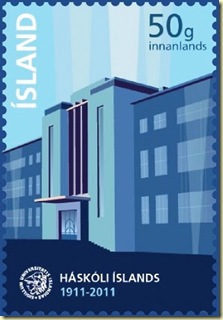
The University of Iceland – 100th Anniversary

The University of Iceland was founded in 1911, uniting three former Icelandic schools of Theology, Medicine and Law. In addition there was a faculty of humanities. During its first year of operation 45 students were enrolled. The first Rector of the university was Björn M. Ólsen, a professor in the faculty of humanities. The current Rector of the University of Iceland is Dr. Kristín Ingólfsdóttir, the first woman to hold this position. The University was originally housed in the Icelandic Parliament building but in 1940 it moved into the University’s main building.

The University offers diverse fields of study along with continuing education. In recent years there has been some major restructuring. In 2008 the university was divided into five different schools with 25 faculties. Simultaneously, Iceland University of Education was merged with the University of Iceland to become its School of Education.

: Iceland Post – Nordic Stamps

Club News

image

National Numismatic Exhibition

May 6-8: Bangalore, Timings: 10am to 7 pm

Organizers: Marudhar Arts

Venue: The Bell Hotel, Adjacent to City Railway Station & Opposite Majestic Bus Station

Website: www.marudhararts.com/exhi.php

Mudhar Arts is organising its first National Numismatic Exhibition from May 6 to May 8. The exhibition will give Bangaloreans a sneak peek into the rich heritage of our country and other countries and the opportunity to discover interesting stories behind the various coins, stamps and notes.

The exhibition will showcase coins, stamps and bank notes from all over the world. The first postage stamp to be printed will also be put on display apart from coins and notes from the various kingdoms like the Mughals, Persians, British and others. Visitors can get to see different coins and bank notes from India and other parts of the world. One can also see the different materials used to mint coins and make notes. Coins were minted and stamps are printed for various occasions and festivals. One can also observe the occasions that were celebrated by the various kings and rulers of the past at the exhibition.

Read More

26 March 2011

Endangered Birds from Iceland…

World Wide Fund for Nature will celebrate its 50th anniversary this year. On this occasion Iceland Post issued 4 stamps with endangered birds as motifs on 27 January 2011.

EB 1

Barnacle goose (Branta leucopsis) migrates mainly from northern regions. These birds stop over in Iceland for some weeks every year. The breeding population has increased somewhat in the last few decades.

EB2

White-fronted goose (Anser albifrons) is a migratory bird in Iceland. The population numbers around 25.000 birds and has been decreasing during the last decade.

EB 3

Common scoter (Melanitta nigra) is one of the rarer species of ducks breeding in Iceland. It is a migratory bird and is wholly protected in Iceland.

EB4

Gadwall (Anas strepera) was probably first seen in Iceland in the 19th century. It is estimated that the breeding population numbers 200–300 pairs, mainly around Mývatn. It is a migratory bird with its main winter quarters in Ireland. It is wholly protected in Iceland.

17 March 2011

New Stamps on Bird and Lighthouses..


light house

Date of  Issue – 17 March 2011

Iceland post  is releasing a beautiful lighthouse set of two stamps  today on “Langanes lighthouse”.

A lighthouse was established for the first time at Fontur in Langanes in 1910. This lighthouse was of the same type as those established the year before in Reykjanes and Öndverðarnes. In 1914 a 3m high iron-frame was erected and equipped with the lantern of the earlier lighthouse. A new lightouse was built in Langanes in 1950. The lantern and gallery are of Swedish make, 3,5m high with a concrete foundation and a copper roof.

light house

The Langanes lighthouse is a concrete 6m high conical tower on a low foundation. Stokksnes lighthouse. At Stokksnes by Vestrahorn a 15m high iron-frame was erected in 1922 with a 3,5m high lantern. In 1946 a new lighthouse was built of concrete at Stokksnes. In 1958 a new lantern was installed along with concrete walls and a copper roof. A year later the lighthouse was powered by electricity for the first time, gas being used as an extra. The Stokksnes lighthouse is a triangular, conical 16m high tower. It was coated with light quartz and got a grey caulker finish in 1988. All lighthouses in Iceland are owned and operated by the Icelandic Maritime Administration.

image

Bird of the Year - Eurasian Curlew

image


On March 14, 2011 Belarus issued a new stamp in its "Bird of the year" series featuring Eurasian Curlew.

There are logos of the International organization of birds protection "BirdLife International" and Belarus public organization "Ahova ptushak Batskaushchyny" (APB) on the stamps.

image

image

The Eurasian Curlew, Numenius arquata, is a wader in the large family Scolopacidae. It is the one of the most widespread of the curlews, breeding across temperate Europe and Asia. The largest wader in its range, at 50-57 cm length, and a 1 m wingspan. It is mainly grayish brown, with a white back, and a very long curved bill. Males and females look identical, but the bill is longest in the adult female. The familiar call, from which this bird gets its name, is a loud curloo-oo.

image

Related Posts with Thumbnails