Showing posts with label Romania. Show all posts

17 September 2024

New Stamps from India


Joint Stamp Issue - India Romanis
Folk Costumes
75 Years of Diplomatic Relations 


Date of Issue : 17 September 2024


Stamp Issue from Romania


Image source : Pradip Jain - Patna  ; Romefilatelia

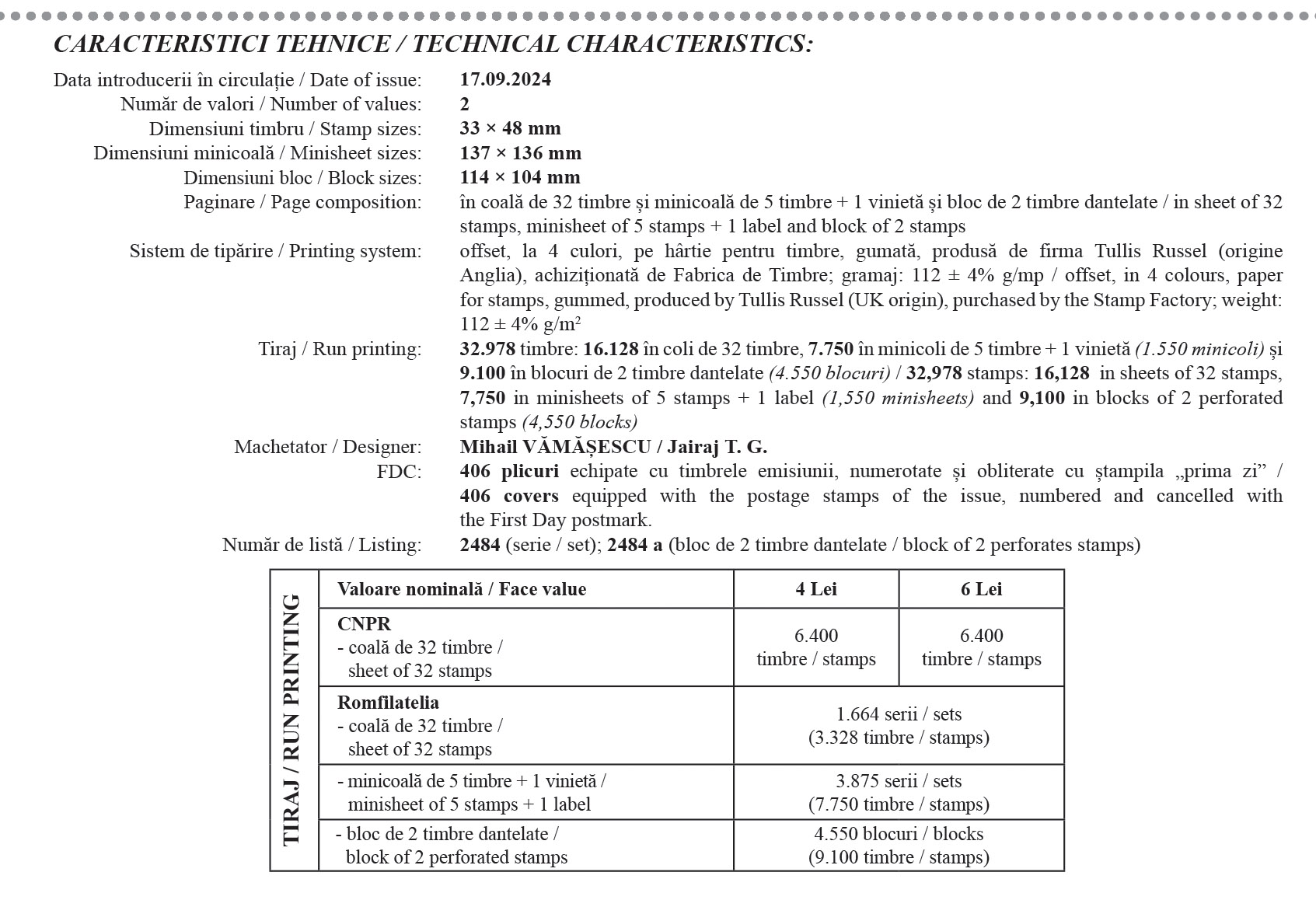
Romfilatelia introduces into circulation, on Tuesday, September 17th, this year, the joint stamp issue Romania-India, having the topic Folk costumes. The issue includes two postage stamps and a First Day Cover showing folk costumes belonging to well-known traditional wear from Romania and India.

The postage stamps issue is registered as a remarkable cultural event meant to mark the anniversary of 75 years of Romanian-Indian diplomatic relations.


Diplomatic relations experienced a visible dynamic, starting with 2013, when the Joint Declaration regarding the Extended Partnership between Romania and India was signed, in New Delhi. The meetings at governmental level, organized especially after the first mutual visits in 2018, led to the development of the Romanian-Indian collaboration in important fields such as: economy, trade, agriculture, petrochemical industry, culture, science and technology, higher education and research, tourism, etc. India currently ranks second in Romania’s trade exchange with the Asian area.

In the field of cultural cooperation, it is worth noting the Romanian Language, Culture and Civilization Lectureship at the University of Delhi, reopened in 2023, the Hindi Language Department at the University of Bucharest and the Cluj Centre for Indian Studies at Babeș-Bolyai University in Cluj-Napoca, starting with December 2024.

The postage stamp with the face value of Lei 4 shows a traditional ensemble of Indian costumes. The women’s costume Lehenga Choli stands out: a skirt and blouse that represents a ceremonial costume. To the long, pleated, usually embroidered skirt is added a blouse cut to fit the body and an element representing a fabric (odhani), richly decorated with floral elements, which amplifies the elegance of the costume.

The men’s costume consists of the dhoti (similar to trousers) and the kurta, a loose, collarless shirt traditionally made of cotton or silk. It should be noted that the dhoti is fashioned out of unstitched cloth, with a length of around 4.5 meters, wrapped around the waist and the legs and knotted either in the front or the back.

The postage stamp with the face value of Lei 6 reproduces the image of a set of costumes from Bihor, which includes, for the women’s costume, the shirt (spătoi) and the skirts (poale) pleated on the waistband, with several frills. The long cashmere kerchief (basma) and then the suman (long wool coat) complete the costume. The men’s costume, with a short shirt, wide trousers and a cloth apron (zadia), also includes the astrakhan hat and long boots.


New Special Cancellation


14 September 2024 : World First Aid Day : Bengaluru


- Praveen Shastry, Bangalore


Special Picture Postcard issued by Postcrossing Society of India, Bangalore on World First Aid Day


- Col Akhil Kumar, Bangalore

31 January 2022

Give your Car a Day Off !


Green Friday : "Give your Car a Day off"


Here is a beautiful set of stamps and a miniature sheet issued by Romania Post campaigning for the environment protection through these stamps with the theme : " Give your Car a Day Off ". The stamps are wonderful with great idea and can be implemented by countries to save the environment. 


Stop! Today The Car Is Standing Still !


Romfilatelia once again urges responsibility for environmental protection, joining the “Green Friday” campaign, initiated by the Ministry of Environment, Waters and Forests, through the postage stamps issue with the theme: “Give your car a day off!”, which were put into circulation on Friday, January 28th 2022.


The Ministry of Environment, Waters and Forests (MEWF) initiated and launched the “Green Friday” campaign on the 12th of March 2021 in order to promote alternative means of transportation. The campaign, baring the slogan “Give your car a day off!”, urges employees of the public sector in Romania to use alternative means of transportation instead of cars on Fridays in order to decrease pollution and lower carbon emissions and encourage the use of pedestrian traffic for the benefit of health.

12 April 2020

Greetings on Easter


Happy Easter


Date of Issue : 13 March 2020


Date of Issue : 12 March 2020


Date of Issue : 27 March 2020


Date of Issue :11 March 2020


14 September 2019

Exotic Birds on new stamps from Romfilatelia


Date of Issue : 14 August 2019

Here is a wonderful set of stamps recently issued by Romfiletelia. The stamps feature colorful exotic Birds. Its a beautiful set of stamps and First Day covers featuring 7 lovely birds. 'Birds'  is one of the most popular topics among stamp collectors. This set will definitely attract every bird lover as well as  Thematic collector !


The bird of the big paradise - Paradisaea apoda, is illustrated on the first stamp of the show, with the value of 1.40 lei.
Measuring approximately 33cm, it is one of the most beautiful birds in the world, despite its bright appearance and is difficult to detect in the forest environment.
Birds of paradise are part of the family Paradisaeidae, family comprising over 50 species of birds characteristic forested regions of New Guinea, the Moluccas et and northern Australia. An original feature of these birds is formed by the highly modified ornamental feathers. The sexual dimorphism is very pronounced, the females having the dark unicolored plume, while the plumage of the males is very alive and varied in color, thus being considered among the most beautiful birds in the world.
Their shrill cry, which sounds like an echo through the forest, is the element that betrays their presence. They drop down from the branches in the crown, launching their cries very quickly, about one per second.
Males live in groups, separated by females, and gather near certain trees they use during mating rituals. They feed on what they find on the trunks of the trees, but also with molluscs, arthropods, reptiles, fruits and seeds.
They nest in the trees, making a nest in the shape of a cup. The tip consists generally of two very variable eggs in terms of color.

The Quetzal - Pharomachrus mocinno , shown on the stamp with the face value of 1.60 lei , is part of the Trogonidae family , and can be admired in areas of North and South America, where it populates forests from altitudes between 1200 and 3000 m high. .
The name "Quetzal" itself comes from the Aztec word "quezalli", which means beautiful or precious, which is also why it has become an endangered species. Quetzal is admired by people for a long time, being the national bird of Guatemala since 1871 and considered a symbol of the gods by the Aztecs of Central America, and the feathers could only be worn by the tribal chiefs. The second largest city, after the capital city of Guatemala City, is called Quetzaltenango (which translates to "Quetzal Place"), which shows the appreciation for this very special bird. The bird attracts curious tourists and brings important incomes from tourism.
Considered one of the most spectacular birds in the world, Quetzalul lives between southern Mexico and Panama, being very easy to spot due to the plume of very bright colors.
Their chest is bright red, contrasting with the feather of the jade color, and the white cod feathers, contrast with the green cod feathers.
During the mating period, these are the easiest to observe, especially because the male undergoes physical changes, growing long feathers (which can measure up to 1.40 m). They can also be twice the length of the body and reach the true tail. These new feathers are protected by the male, by modifying the flight, he first leaning back, and not in front, as the birds generally do, so as not to damage them.
The nesting period lasts from March to June. During the egg hatching period (blue), the females sit in the nest with their face facing the entrance and hold their feathers bent. This period lasts from April to August, the bird stopping twice, often preferring to do so with other birds in holes of rotten trees.

The red- breasted toucan ( Ramphastos dicolorus ), illustrated on the stamp with the value of 1.70 lei , is a bird of the Ramphastidae family living in southern and eastern Brazil, Pantanal in Bolivia, eastern Paraguay and northeastern Argentina. It is found primarily in the Atlantic forest. In general, it is quite common and yet it is the attention of IUCN (International Union for Conservation of Nature).
It is one of the smallest species of toucans, with a weight of 265-400 grams and a total length of 40-46 cm. Its beak is one of the shortest of these species of toucans, only about 10 cm long. His chest is, in fact, orange, with yellow on the sides. The beak is mostly pale green.
Toucans are monogamous birds, forming pairs for life. They are arboreal birds and nest in tree holes, the females laying 2-4 white eggs. The incubation period is 2-3 weeks. The chicks do not leave the nest for 2 months and only after this period begin to fly. Toucans are consumers of fruit, but they also feed on insects and other small prey.

The northern royal lizard - Onychorhynchus mexicanus, represented on the stamp with the face value of 3.10 lei , belongs to the Tityridae family .
It measures approximately 18 cm and is easily recognizable by the distinctive ridges of the ridge, which it rarely shows outside the mating period. The head and wings are brown, with the sides of the head more gray. It has a white neck, with a gray chest, the ventral parts are yellow, and the tail has a cinnamon color, with the tip closed. The spectacular element of this species is the ridge, which is folded over the head, in the form of a semicircle, which, when unfolded, is red with blue marks.
What is truly spectacular is their shout, composed of a series of whistling notes.
It is found in the southeastern parts of Mexico, northwestern Peru and Bolivia, in Venezuela or southeastern Brazil. Its natural habitat consists of subtropical or tropical moist forests.
The American flamingo - Phenicopterus ruber , whose image is reproduced on the stamp with the value of 5 lei , is a gregarious bird, belonging to the family Phoenicopteridae . Measuring 145 cm, the American flamingos is an easily identifiable bird due to the glossy feather, with reddish tints on the neck, and the body has a pale pink hue, like the beak, which has a black tip. The wings have feathers and portions of black. The arched and thin neck and the long, delicate legs were represented even in the primitive rock paintings.
The very special color is given by the omnivorous food, consisting mainly of algae and small living things. The way it feeds is completely unique and unique, with the flamingos walking their heads underwater, using their long neck, which allows for the filtering of a large amount of water, while flowing with the unusual bumps from one side to the other. Because of the way they feed, they are vulnerable to changes in habitat, such as pollution in the areas they populate.
Flamingos are gregarious birds in all seasons, forming huge and dense colonies during the breeding period, in which each pair defends its restricted territory around the nest. They are monogamous birds.
The nests are cone-shaped, and are constructed of mud, with a slight depression at the top. I deposit a single tip per season, usually consisting of a single egg. Incubation is provided by both sexes for 27-31 days.
American flamingos live in the Caribbean Islands, Mexico, the northern coast of South America and the Galapagos Islands.
The bird of paradise Carabinier - Ptiloris magnificus , illustrated on the last stamp of the series, with the face value of 19 lei , is a member of the family Paradisaeidae of the order Passeriformes , being easily recognizable due to the color of its plume. It measures up to 37 cm, the males have a dark color and a short tail, the beak is long and an iridescent bluish portion on the crest and chest, and the females have the elongated beak and are brown in color, with stripes on the ventral sides.
The distinctive parade of the male of this species involves the swelling of the feathers on the chest and the extension of the wings, exposing itself especially in tall trees and climbing plants.
The nest of these birds has a deep dome, often built in a palm tree or similar trees.
They are widespread in the region of New Guinea and Queensland, Australia, preferring forest areas usually located at higher elevations and feeding on fruits and invertebrates.
The wonderful hummingbird - Calothorax pulcher, a bird illustrated on the two envelopes on the first day of the show, is part of the Trochilidae family , a large family of over 400 species spread only in the New World, from Alaska to the Fire Country, from the shores of the oceans. to the eternal snow of the mountains, but the family is best represented in the tropical area of ​​South America.
Known as one of the smallest birds on Earth, the wonderful hummingbird measures 5cm on average. It is easy to recognize, due to the multicolored plume, the males having the green-gold dorsal parts, with the black tail and wings, the whitish ventral parts, greener on the flanks, and on the neck they have a dark pink feather collar with purple markings. A distinctive feature is the long, narrow, curved and black beak.
The females do not have a bright color on the neck, have a light yellow hue
on the ventral sides and a pale gray stripe under the eyes, the tail feathers being predominantly black, with a brown base and white tip.


Club News

Stamp Design competition in Akola


A stamp designing competition for 2019 children's Day was organized by India Post in Akola on 12th September 2019.  40 students participated in this competition. They drew  beautiful designs on the  subject of "Child Rights".
These designs will be sent to New Delhi for final selection of the design for 2019 Children's Day stamp.
These designs were exhibited .at Nishu Nursery & Kothari Convent School, Gaurakshan Road, Akola 444 001. Maharashtra.
-Ajay Agrawal, Akola

28 May 2019

Indian theme on foreign stamps


Indian Peafowl on new Romanian stamps


Date of Issue : 17 May 2019

Romfilatelia issued  a set of postage stamps  with the title Peafowls, on  May 17th, 2019. Peafowls are named in the Indian mythology the “the gods’ vehicles”, because the legend says that Shiva’s son, Karthikeya, is represented flying on the back of a peafowl.


The peafowl originates in Sri Lanka and India, but the beauty of its plumage has made it spread even in other parts of the world, being adopted as an ornamental bird. In other times, the peafowls were a symbol of opulence, being present in the gardens of European noble families. The male’s tail is the element that defines the exotism of the species and the main reason they are known throughout the world. Besides the multi-coloured plumage, they distinguish by their intense cries and elaborate mating dance. The peafowl is a solitary bird, diurnal, and sleeps in the trees to protect itself from predators.


It is one of the largest flying birds, but spends more time running, than flying. The average lifespan of the peafowls in captivity is 25 years, and in the wild they live to the age of 30 years. Peafowls are omnivores, and their diet consists of plants, ants, seeds, locusts, termites, ticks, petals of flowers, reptiles, amphibians and arthropods.

The Congo peafowl or the African peafowl (Afropavo congensis) is spread in the tropical rainforests of the Congo River, and is illustrated on the first postage stamp of this issue, with the face value of Lei 1.80. This type of peafowl has a large-size appearance. The length of the male is up to 70 cm, with a short tail measuring between 23-26 cm and the females have dimensions between 60-63 cm, with a tail between 19.5 and 22.5 cm. The difference in weight between the sexes is considerable, the males weighting 1,475 g, and the females weighting 1,154 g.

Their plumage is special, with white stripes on the crown, some specimens having their neck partially discovered.Their habitat is varied, usually choosing lower areas below 1,200 m in altitude, being very difficult to spot in the wild.

The green peafowl (Pavo muticus) is part of the peafowl family (Phasianidae), the Galliformes order, originating in India, Sri Lanka, Pakistan, Bhutan, Bangladesh or Nepal, and is represented on the second postage stamp of this issue, with the face value of Lei 5. 

It is divided into three races: Pavo muticus spicifer, pavo muticus imperator Delacour and Pavo muticus Linnaeus, the races having varied colour feathers, an element through which they are differentiated.

The males measure between 180 and 250 cm, with a tail that can be between 140 and 160 cm. Their weight varies between 3,850 g and 5,000 g. Females measure 100-110 cm, with a tail that can reach up to 45 cm. Females resemble males, but they have shorter legs and do not have the plumage so brightly coloured, a feature which makes them very difficult to confuse. They set up in open forests or at their periphery, but avoid tropical forests, preferring a habitat at altitudes ranging from sea level up to 3,000 m.


The Indian peafowl (Pavo cristatus) is of a legendary beauty, declared the national bird of India, known in two colour variants: blue and white, the subspecies being represented on the third and fourth postage stamp of the issue with the face values of Lei 8.50 and Lei 12. It is part of the family of peafowls (Phasianidae) and of Galliforme order, originating from India.

Males at adult age have a length of 180 to 230 cm, their tail measuring between 140 and 160 cm and their weight ranging from 4,000 to 6,000 g. The wingspan of this species varies between 130 and 160 cm. Males have a distinctive morphological appearance, and their open tail is in the shape of a fan.

Females are smaller and measure between 90 and 100 cm, with a tail measuring between 32.5 and 37.5 cm, with an average weight of 2,750 to 4,000 g. The wingspan of the females is from 80 to 130 cm.

There are varieties of the Indian peafowl feathers. One of the most spectacular Indian peafowls is the white peafowl, which is not albino, but is a pure species, with hazel eyes. The Indian peafowls choose to set up in open forest areas with shrubs, but at an altitude of up to 2,000 m.


12 April 2017

Symphony of Tulips


Date of Issue : 7 April 2017

Here is a beautiful set of stamps issued by Romania Post featuring famous flower exhibition in Europe. The “Symphony of Tulips” is the most important social-cultural, artistic, sporting and commercial manifestation for the Pitesti municipality. This spring, Romfilatelia dedicates the postage stamp issue Symphony of Tulips, to the city of Pitesti and its main manifestation.


The exhibition’s tradition is long, and Pitesti became associated with the idea of the city of tulips. The first edition took place in early May 1978 and delighted the residents by the richness of colours. The “Symphony of Tulips” is the second oldest dendrological and flower exhibition in Europe, after that of the Dutch city of Tynaarlo.

Although this year’s event lasts three days, the floral arrangements are planned to last as much as possible by overlapping the flowering periods and combining tulips with other background flowers, such as pansies or common daisies. The collection is structured on the principles of landscape architecture and follows harmonious geometric lines. Plants are grown and bred both domestically and abroad, in countries with a tradition in the field, such as the Netherlands, Czech Republic and Poland.

Native to Central Asia and the Middle East, tulips were considered a luxury and were first introduced into Europe in the 16th century from Turkey. Presented in a variety of colours, tulips symbolize elegance and grace: the yellow tulip stands for cheerful thoughts and sunshine; orange represents fascination, happiness, and warmth; white asks for forgiveness; red signifies true love and romance; those that are almost black in colour represents the heart of a lover.

During the event, artistic and cultural events take place, such as international scientific symposia, flower parade, folklore and pop music shows, painting exhibition and the “Tulips Cross”.

The stamp issue depicts the images of four representative buildings for Pitesti, in terms of administrative, historical and cultural heritage, which are accompanied by the enchanting colours that the Symphony of Tulips pours over the city.

The postage stamp with the face value of Lei 2.50 illustrates Pitesti City Hall, built in 1933 as headquarters of the Financial Administration and which became City Hall in 1968.

Built in Neo-Romanian style, the edifice has as author the architect State Cintan (1876-1940), who combined archaeology and ethnography in his works, and was very susceptible to local architectural traditions. Thus, the central hall was conceived as a patio covered by a spectacular skylight.

The stamp with the face value of Lei 4 presents the County Museum, the former palace of the Prefecture of Arges County, a beautiful Neoclassical building (1898-1899). It hosts significant evidence of the town’s history and that of Wallachia. Near the main building, two new modern buildings complement the museum.

The postage stamp with the face value of Lei 4.50 presents the headquarters of the “Rudolf Schweitzer - Cumpana” Art Gallery, built in 1886, in the Neoclassical style, and the former headquarters of Pitesti City Hall, until his move to the current location in 1968. The interior was done in French eclectic style, with a spacious hall and monumental staircase, which is in harmony with the valuable museum pieces it shelters. In its rooms are exhibited by Nicolae Grigorescu, Stefan Luchian, Theodor Pallady, Gh. Petrascu, Rudolf Schweitzer-Cumpana and Nicolae Tonitza attracting visitors’ attention to important moments in the history of Romanian fine arts.

The stamp with the face value of Lei 16 illustrates the Court of Appeal, a Neoclassical building from 1914. The architects Eracle Lazarescu and Arghir Culina designed a monumental construction, in which light transforms into a genuine element of creation and invited to animate the space through central hall skylight.

Source : Romfilatelia 


27 March 2017

New stamps for Flower Lovers....


Flowers, National Symbol


Flora, a beloved theme for those passionate by philately, is once again taken up this year by Romfilatelia within the postage stamp issue “Flowers, National Symbol”. Together with the symbol flower of each state, the national flag completes the stamp illustration.

Romania is bordered by Bulgaria to the south, Serbia to the southwest, Hungary to the northwest, Ukraine in the north and east and Moldova to the east and the Black Sea to the southeast.


The peony whose image is reproduced on the stamp with the face value Lei 1.50 is a flower species unique to Europe. In the country there are five nature reserves for Paeonia peregrina in Teleorman, Mures, Olt, Dolj and Giurgiu.

Romania’s national symbol flower, the peony, is also known under the name of the Palm of the Lord’s Mother (verbatim). All its other names are popular, archaic and describe the Romanian peony. In popular culture, the peony is often associated with longing, with physical beauty or love.


The symbol flower of the Republic of Moldova is the basil, whose image is reproduced on the stamp with the face value of Lei 4.50.

To the left of the Prut it’s one of the most beloved and sung plants. Because of its special aromatic oils and its preservative properties, basil is used in the Orthodox Church rituals to produce holy water, having the role of chasing away evil spirits. At the same time, in local tradition this plant is considered the flower of love and luck; it is also present in most magical practices for marital purposes. In popular medicine, basil is used as a plant with talismanic properties for memory improvement and as an anti-stress remedy.


The Republic of Croatia’s national flower, illustrated on the stamp with the face value of Lei 8, is Iris croatica. The Croatian name for this flower is Perunika and comes from the name of Perun, who was the greatest god of thunder and lightning in Slavic mythology. Legend has it that Perunika will only grow in the place where the god Perun’s lightning struck.In 2000, the Croatian Academy of Arts and Sciences proclaimed the Perunika as Croatia’s national flower.

Iris croatica is distinguished primarily from many other subspecies by the greatness of all its plant parts, the flowers being oval and richer. We can admire the beauty of the iris flowers in summer and autumn. About the gorgeous purple flower, herbalists claim that it is a simple remedy to keep a variety of diseases under control. The gorgeous flower that we find in gardens, parks and even in pots on terraces is a less known cure.

Bulgaria, a beautiful country in the Southeast European continent, has the rose as a national symbol. Rosa damascena whose image is reproduced on the stamp with the face value of Lei 15 is a symbol of this country, considered a worldwide brand, and the wide range of cosmetics that have rose aromas are called “Bulgarian gold” or “liquid gold”.

Rosa damascena or Kazanlak Rose is a highly fragrant flowering plant from which essential oil, confiture and syrup are extracted. From this variety of rose one can extract 30% more oil than of any other rose. The pink flowers have about 30 petals, hence the name of Trigintipetala.


Related Posts with Thumbnails